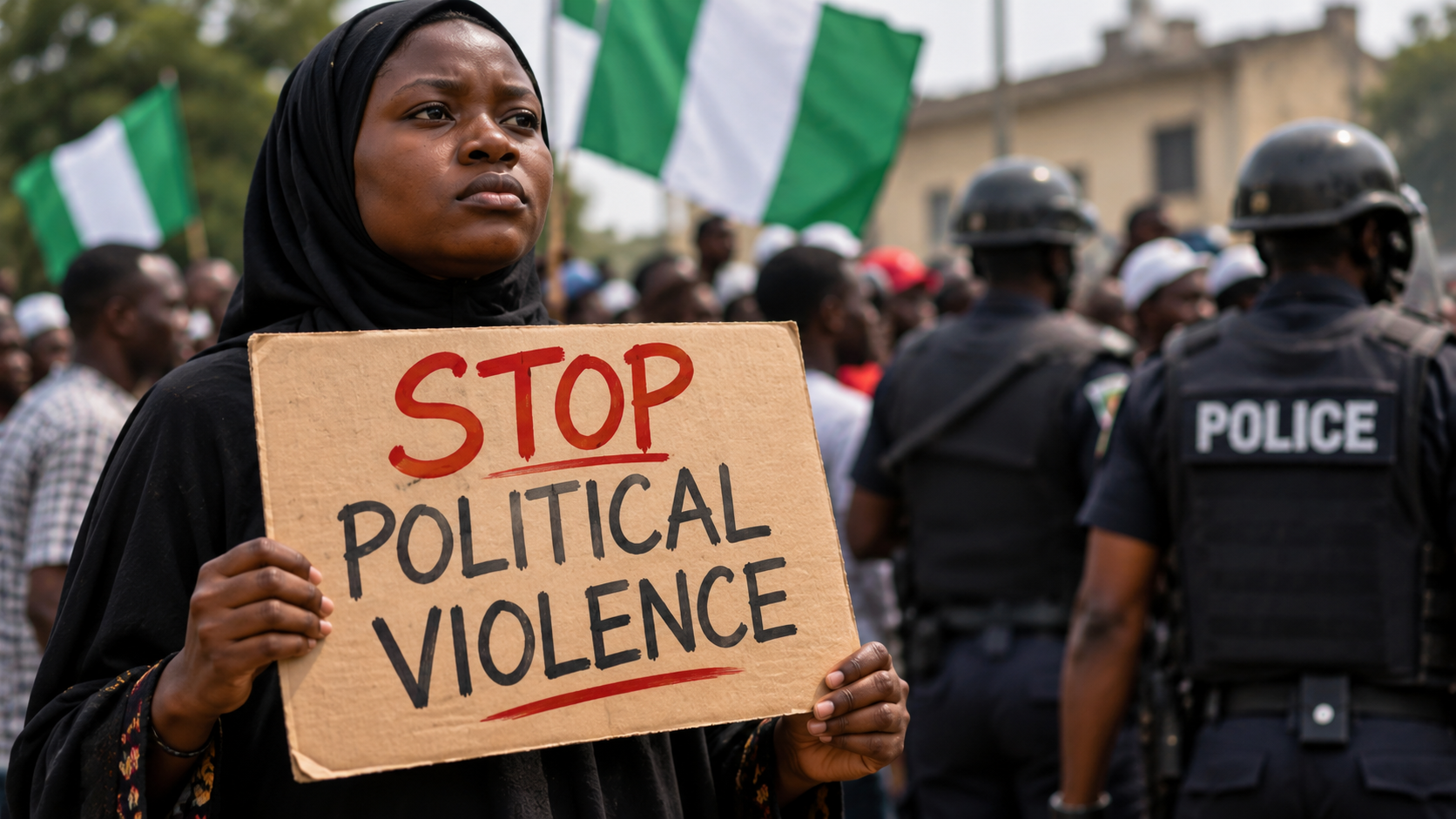
Political violence is the use of threats, physical force, or even deliberate violent attacks to silence opponents or influence political decisions. Contrary to the common belief that political violence happens only during elections, it can occur before, during, and after elections. In the past six months, the number of cases involving political violence in Nigeria has increased. This is no surprise since the 2027 Presidential Elections are just days away. Well, even with the dates of the election drawing near, it shouldn’t serve as a justification for political violence.
There’s no doubt that if this attack continues, it could threaten the peaceful nature of the elections. So, that raises the question, “What is the Solution to Political Violence In Nigeria?”
This article is going to give an answer to that question. However, before delving straight to the answer, let’s begin by first identifying the causes of political violence in Nigeria.
Why Is Political Violence Becoming a Serious Problem in Nigeria?

Here are possible reasons why political violence in Nigeria is on the rise:
1. Desperation to Gain Power by Politicians
One of the main reasons why political violence persists in Nigeria is because of the intense desperation for political power by many politicians. In fact, many politicians who contest for positions in Nigeria do not view the position as an opportunity to serve the people but as an avenue to gain more influence.
As a result, this wrong view of office has caused them to see the political positions that they contest for as a do-or-die affair. Now, what this mindset does to these politicians is that they may see violence as the only way to weaken opponents.
This is done especially when they see the opponents as threats to their victory in the polls. They could even go ahead to pay armed thugs to disrupt the political campaigns of their opponents.
2. Weak Law Enforcement
Another cause of the rise in political violence in Nigeria is the weak law enforcement effort. In Nigeria today, there is a belief that those who perpetrate violence can escape prosecution especially if they are connected to influential political figures in the country. So, those who plan on perpetuating violence may feel that they would have a free ride and there would be no consequence for their actions.
On the other hand, there have also been accusations that security agencies, which are supposed to protect the masses from violence, may at times be compromised. As a result, these compromised officers may turn on the other side even when crime is being carried out before their very eyes.
An example of this occurred as reported by Punch Newspaper on November 12, 2026, when the NDC political party held its meeting in Lagos State. After the clash with thugs who came to disrupt the meeting, the party through its Publicity Secretary, Olushile Akinyemi, alleged that security operatives, including personnel of the Department of State Services (DSS) and the Nigerian Police Force, failed to intervene to protect them.
In his words, he mentioned that the DSS and the Police, who were present at the occasion, “stood down”and “watched them unleash terror”on them.
So, this example reflects the fact that the law enforcement agencies are not innocent of the accusations thrown at them for indirectly aiding political violence in Nigeria.
3. Poverty and Unemployment
It is no news that the economic situation in Nigeria has created conditions that politicians have exploited and continue to exploit. The facts have shown that people who are often used as political thugs are young people who struggle to eat or have meaningful jobs. Yes, as such, they become vulnerable to politicians who would promise them money in exchange for disruptions at political functions.
For many young people, the recruitment into becoming a political thug is not direct. It usually begins when the young person is paid to show support for a particular candidate in a rally. After a while, when the arrangement goes on for a particular period and the payment keeps coming, that arrangement can gradually become more demanding and dangerous.
The same person may later be asked to disrupt an opposition rally or prevent people from carrying out their political activities freely for a bigger pay. You’ll agree that for someone who has no reliable source of income, the money offered to him would be difficult to say no to. If the person succeeds, he then becomes a useful tool for politicians to steal ballot boxes and other similar activities.
4. Party Conflicts
As much as political conflicts often occur between two opposing political parties, there have also been cases where internal party conflicts have also led to political violence too. This usually occurs when there is a disagreement in the party over who should be the flagbearer of the party in the elections. When one person is favored over another, violence between the different factions may occur.
The unfavored aspirant who loses a party ticket may feel that his years of political investment have been wasted. Yes, he may feel that money spent on “consultation”and “sorting”has been wasted. As such, the person may resort to physical attacks to ensure that his opponent becomes indisposed to carry out that position.
A scenario where the internal political conflicts led to violence happened during the ADC primary elections for its 2027 National Assembly representatives on May 21, 2026.
In a report by the Premium Times Newspaper, Senator Ireti Kingibe alleged that the senatorial aspirant, Tijani Mubarak slapped the primary election committee, Abubakar Adams Chika. In addition, she also claimed that another House of Representatives aspirant, Dr Fatima Goya was also attacked during the process too.
So, internal political tussles have also driven the number of violence due to political struggles up. However, is there a solution to political violence? The answer is Yes!
The next heading discusses that.
The Way Out Of Political Violence In Nigeria
Below are solutions to political violence in Nigeria:
1. Prosecute perpetrators of Political Violence
The best way to tackle the issue of political violence in Nigeria is to make sure that those responsible must dance to the tune of the law. It even goes beyond just enacting the laws, but enforcing them to the fullest degree possible. In addition to this, police and other security agencies should be neutral when it comes to the political affairs of the country.
They shouldn’t just be on standby waiting to issue a statement after an attack is made, but they should be ready to swing into action when they suspect violence of any sort during political activities.
Furthermore, investigations of political violence should not stop at just arresting the thugs who are present at the scene. In fact, these thugs are just “pawns”in the bigger picture. The investigations should go beyond these “pawns”and move towards the big players. Yes, the big players in most cases are the politicians who provide these thugs with money and weapons to carry out these activities.
If evidence then points to a politician, the person should be investigated. If possible, the politician should be made to withdraw immediately from the electoral process and face the full wrath of the law by all means.
2. Strengthen INEC and Other Electoral Institutions
The issue of solving political violence would not be complete without mentioning the Independent National Electoral Commission (INEC). Yes, INEC has an important role to play in performing its civic responsibility without fear. On the outside, it seems INEC has only been concerned with registering voters and distributing the Permanent Voters Card (PVC).
However, their role should extend beyond that. In order for the 2027 elections to be conducted smoothly, INEC must collaborate with security agencies to identify areas where political violence may be likely to occur and mobilize tight security at those locations.
For example, in each state, a detailed security intelligence report should be done. Now, if the security reports show that members of the different political parties are threatening one another in a particular community, INEC and the security agencies should immediately swing into action.
In carrying out this role, no stone should be left unturned as any missed details could prove to be disastrous in the long run.
Also, INEC must also ensure that electoral activities under its supervision are conducted transparently. The truth is that many resort to political violence because they feel that INEC is not able to provide a free and fair election. So, in light of this, INEC should take seriously its role in providing a fair election that is satisfactory. Where there is evidence of electoral malpractice, the commission should work to use its legal powers to cancel the result of such an election.
3. Political Parties Should Be Responsible for Conduct
Political parties should be ready to be held responsible for the conduct of their members. Yes, a political party whose members are known for physical attacks against one another shouldn’t be allowed to qualify for any electoral process.
To be able to lead the office in Nigeria, the political party that the politician represents should be of good conduct. Of course, what this would mean is that political parties would no longer recruit political thugs. In fact, this would further go to promote discipline in the political party.
With time, politics would no longer be seen as a do-or-die affair but as a means to serve the people in the most peaceful way possible. In addition, it would go a long way in helping members of political parties settle disagreements through the lawful procedures.
4. Address Youth Unemployment
As mentioned earlier, the worsening economic state of the country is a cause of political exploitation of our youth. To solve this problem, the government should open up access to employment or skill acquisition programs. These programs would help to keep the youth’s eyes away from depending on politicians for survival.
Politicians should stop weaponizing poverty in order to take advantage of the youth. Instead, the focus should be to create opportunities as possible to keep the mind of the Nigerian youth busy.
Conclusion
In 2026, political violence shouldn’t be an issue that should still be contended with in Nigeria. As a nation, we should have grown past this stage. However, the system in Nigeria has directly and indirectly promoted the rise of political violence in Nigeria today. To this end, this article has highlighted the causes of political violence, which include desperation by politicians to attain power, poverty and unemployment, as well as weak enforcement agencies. In addition to that, you have also read the solution to political violence in Nigeria. All in all, politics can be done without the exchange of blows and threats. So, maintain peace by refusing to be a tool for political violence.