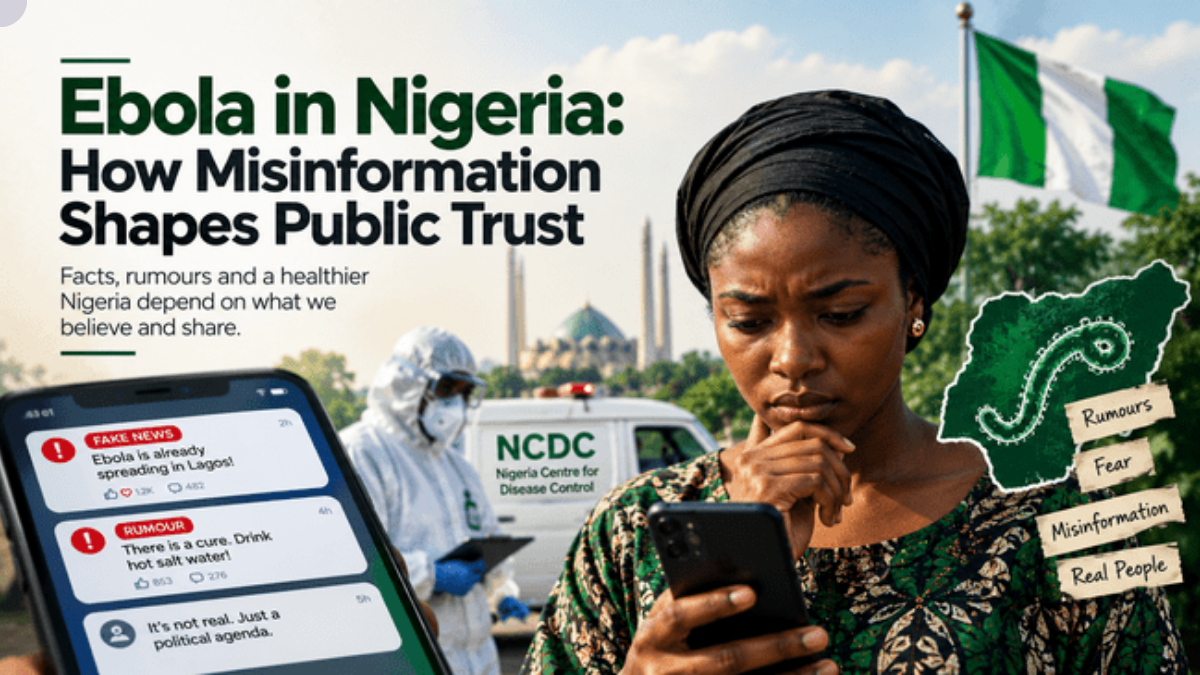
Ebola in Nigeria is now a confirmed fact, not a distant warning. The Federal Government announced a case in Abuja after laboratory confirmation on October 20. The patient is a woman who recently arrived from Uganda. The NCDC’s laboratory director later said the strain is Bundibugyo, and health teams are tracing 44 close contacts.
The virus spreads through contact. Rumours spread through doubt. How Nigerians respond over the coming weeks will depend less on the facts themselves than on whether people believe the voices sharing them. This article looks at how misinformation fills gaps, why a new strain widens those gaps, and what builds trust back.
Why Ebola in Nigeria Feels Different This Time
Nigerians remember 2014. That outbreak brought panic and harmful home remedies, including the belief that drinking salt water could protect you. Fear moved faster than facts, and people paid the price.
The country also remembers how it won. Officials have credited the 2014 containment to strong leadership, careful surveillance, and steady public communication. That memory is useful. It can also mislead. Many people now assume Ebola is a problem Nigeria already knows how to solve, which makes this outbreak easier to underestimate.
How Misinformation Spreads Around Ebola in Nigeria
Rumours did not wait for a confirmed case. In May, the NCDC had to push back on claims that Ebola was already spreading widely across the country. It also corrected a false claim that Ebola and Hantavirus are the same disease.
Now that the case is real, reactions have split. Some readers commenting on news coverage insist no case exists. Others distrust the official account from the opposite direction and assume the truth is worse. Both groups share one root problem. When people doubt the source, they stop acting on the message.
Researchers at Nigeria Health Watch describe the pattern simply. When official channels are slow or unclear, rumours fill the gap. Rumours are not random noise. They answer a real need for certainty when the facts feel incomplete.
When Timing Becomes a Trust Issue
Timing shapes trust as much as content does. On October 6, the NCDC said Nigeria had no confirmed Ebola case. By then, the patient had already landed in Abuja on October 3. She sought care on October 11 and was not tested until October 19, after officials learned about her travel from Uganda.
Opposition figure Atiku Abubakar has questioned the nine-day gap between her seeking care and the public announcement. He has also asked for a breakdown of the ₦10 billion announced for preparedness earlier this year. Those are criticisms, and officials may have their own account. Confirming a case takes testing, and responsible agencies verify before they speak.
Still, the sequence raises a fair question about how travel history is screened in private hospitals. Days of care before a test leave room for speculation. Conflicting statements make it worse. Uganda’s health services chief said his country has no confirmed active cases and described the patient as a Nigerian. When official accounts differ, people choose the version they already trust.
Why the New Strain Changes the Conversation
Here the situation gets harder. Unlike the more common Zaire strain, Bundibugyo has no approved vaccine or treatment, and its fatality rate can reach 40%. In the Democratic Republic of Congo, the current outbreak has killed 4,381 people among more than 9,000 confirmed cases since mid-May.
The tools most people associate with Ebola were built for Zaire. The licensed vaccine, Ervebo, and the antibody treatments, Inmazeb and Ebanga, all target that strain. Those successes explain why Ebola feels more manageable than it did in 2014. They do not directly solve this outbreak.
The research gap is real. WHO advisers have said there is no conclusive evidence that Ervebo protects against Bundibugyo, and they recommend using it only inside carefully designed research settings. A vaccine made for this strain is being developed, but it was expected to need seven to nine months before clinical trials begin.
Testing adds another twist. A negative result from a test aimed at the Zaire virus does not rule out Bundibugyo. Someone could hear “I tested negative” and relax when they should not.
This gives misinformation a second opening. One camp says Ebola has a vaccine and a cure, so there is nothing to worry about. Another camp hears “no cure” and panics, or reaches for unproven remedies. Both reactions cause harm. Both grow when people never hear the plain middle: tools exist for one strain, they are still being tested for this one, and early care still matters.
What Rebuilds Trust
Trust comes from habits, not slogans. Four practices matter most.
Speak early and admit what is unknown. Saying “we do not yet know” costs less than correcting a confident claim later.
Name the strain and explain the difference. People can handle “this is not the strain we have a vaccine for.” They struggle with silence.
Use trusted local voices. A community programme in Niger State found that training local participants to spot and manage misinformation worked well. The WHO representative in Nigeria has also urged messaging in local languages that fits local culture. Health workers, faith leaders, and community groups reach people that official statements miss.
Check before you share. The NCDC asks Nigerians to follow its verified channels, including its hotline on 6232.
The basics bear repeating. Ebola spreads through direct contact with the blood or body fluids of a person who is infected, ill, or has died from the disease, and through contaminated materials. Anyone who has travelled from an affected area should monitor their health for 21 days and report symptoms or possible exposure promptly.
Conclusion
Ebola in Nigeria is a health story and a trust story at the same time. The virus spreads through contact, but confusion spreads through gaps in communication. A new strain with no approved treatment makes those gaps costly.
Readers can help close them. Check the source, share only what you can confirm, and report symptoms early.