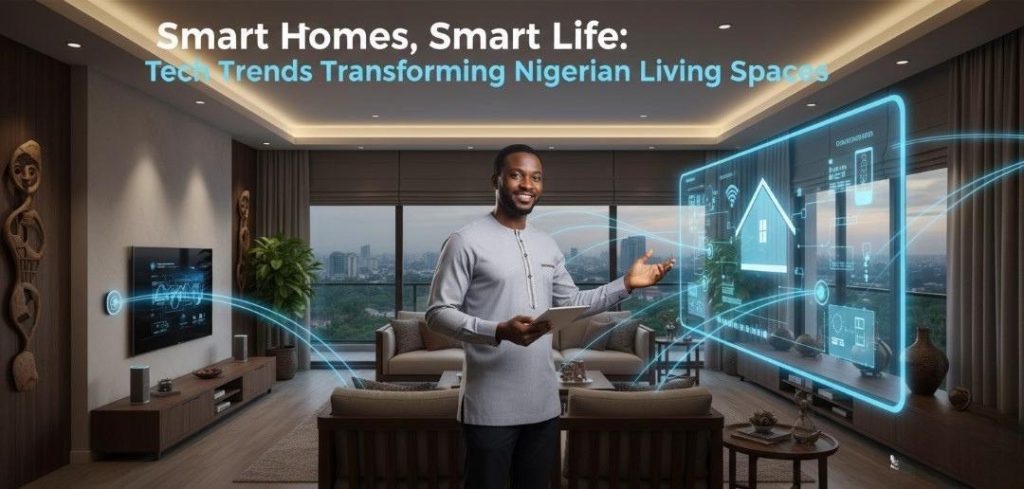
The Rise of Smart Living in Nigeria
In Nigeria today, the concept of “home” is undergoing a shift. The home that used to offer only a place of rest is gradually becoming an ecosystem of comfort, security, and convenience driven by technology. Envision this: you get out of your car, and your lights turn on automatically. The temperature in your air conditioner adjusts to your preferred settings, and your cell phone displays a live video of your front door. No longer science fiction–this is the new normal for an increasing number of Nigerians.
In high-rise apartments in Lagos and new estates in Abuja and Port Harcourt, intelligent home solutions are quietly revolutionizing the world of modern living. The concept of luxury has been given a new dimension – not by being pricey but by being efficient. These solutions are enabling users to better control their surroundings and manage energy, security, and comfort from the palm of their fingertips.
In summary, smart living is not simply a fad in Nigeria. Rather, it represents a lifestyle change that combines the use of technology with life and offers the hope of a future that contains homes that think, act, and react accordingly.
WHAT ARE SMART HOMES?
Smart homes can be described as homes that incorporate the use of internet-enabled devices to enable homeowners to control and remotely monitor various house functions such as lighting, security, appliances, and home entertainment systems.
These devices may include smart light bulbs, smart temperature controls, motion sensors, or door cameras. The devices communicate via an Internet of Things system. This may also be summarized by stating that within your house, your devices talk to each other. You can control them either by your smartphone or by commands.
Smart homes in Nigeria do not only belong to the rich in the country’s economy. This is contrary to the usual trend in other developed countries, where it only existed among the rich sections of society, such as in rich estates.
Common Smart Home Devices in Nigerian Homes
The smart home industry in Nigeria is now rapidly growing, with a wide range of technologies at the forefront.
1. Smart Security Systems:
The main factor that has prompted most Nigerians to invest in smart technology is security. Using motion-sensing cameras and alarms, an individual can monitor his/her house from anywhere.
2. Solar-Powered Smart Devices
In the unstable power distribution system, Nigerians have turned to smart innovations and solar power. Smart inverters and solar power monitoring systems enable customers to track their power consumption as they automatically switch to another power source.
3. Virtual Assistants
For instance, devices like Alexa and Google Home are slowly gaining prominence in Nigerian households and settings where commands can be used to control lighting, music, and appliances.
4. Smart Lighting and Energy Management:
Smart bulbs and energy-saving devices also help save electricity. Many households use applications that enable them to set a timing schedule for turning on or off lights and fans.
5. Home Entertainment and Connectivity:
Beginning with smart TV and sound equipment, entertainment offers another important aspect that gets people on board. The Nigerians involved in streaming services as well as content creation are also embracing the lifestyle that comes with connectedness.
These devices are also being made accessible within the Nigerian context by new startups such as Zsmart Systems, Bluechips Technologies, and KoloTech.
Why Nigerians Are Embracing Smart Home Technology
The factors that contribute to the adoption of smart homes in Nigeria include:
The first advantage it offers is convenience. Nigerians are very busy people. They have jobs, homes, and road traffic. Smart technology helps in making life easier for people by providing convenience.
The second aspect that I consider important is security. Feeling secure in your country can be important to you. Knowing that it’s possible to see your home from afar can indeed give your confidence a tremendous boost. This could be from another city in your country or from another country.
Thirdly, the erratic power supply in Kenya has led to innovations. The world is actually experiencing the birth of «smart» devices that regulate power or function on solar energy.
In addition to that, a higher tech literacy level exists within the younger generation. As a result of the influence of social media and exposure to global knowledge, the benefits that come from intelligent living have become better known within Nigeria. The rising classes within society, as well as affordable devices from companies such as Xiaomi and Oraimo, have made it easy.
Smart Home Technology in Nigeria: Issues
Although there is excitement, some factors seem to slow the acceptance level of smart homes in Nigeria.
1. Internet Connectivity:
Smart homes have become heavily dependent on an uninterrupted internet connection. For some users, however, the absence of good internet connectivity remains a challenge.
2. Device and Installation Costs:
Although the costs of these solutions are now dropping, quality smart systems remain unaffordable within a normal home setting.
3. Limited Technical Expertise:
There aren’t very many local technicians who are well-trained to install and maintain such systems. This has led to reliance on foreign technology and foreign technicians.
4. Privacy and Data Security:
Smart devices also raise various issues relating to privacy and surveillance as a result of heightened fears due to a lack of awareness of cybersecurity.
As for both of them, improved digital networking infrastructure, affordable internet accessibility, and ingenuity that caters to Nigeria’s needs are what the Nigerian government should provide. The Future of Smart Living in Nigeria. The future may offer the answer to the question of how Nigerians may perceive homes in the future. The advent of 5G and new start-ups from Nigeria may unlock the secrets of what it may entail to live smart. Firms within the real estate business may now adopt new technologies and implement an “automated life from design to implementation,” contrary to before, when it was only an emphasis on “afterthought.”
Estates in Lagos, Abuja, and Enugu may offer intelligent access management solutions, energy management solutions, and climate management solutions. The future may also unveil the prominence of “Artificial Intelligence.” Just think of homes that “learn” from your patterns and automatically regulate your lighting, music, and temperature accordingly. These homes used to exist only in the world of fantasy. Today, it may become a reality for Nigerian city life. The new fervent search by the Nigerian government for digital revolution and sustainability may usher in an added incentive.
Innovation, Safety, and Accountability within the Smart Era
As homes become smart, it seems that the residents of such homes should be intelligent as well. These may include having strong password protection, buying from trusted brand makers, and keeping them regularly maintained to avoid being “hacked” and “malfunctioning.” Injunction towards innovations within the realm of “tech” must go hand in hand with intellectual emphasis. The smart Nigerian may comprehend that having a “smart home” that may offer them a new upgrade within their life may now become an opportunity, as it may serve as an addition to better and smarter “living.”
Conclusion
The smart home in Nigeria is now a reality and not a dream. The devices that were needed by an individual to help them save energy, as well as those that entail artificial intelligence concerning the security of homes, are now altering the lives of Nigerians. Challenges exist inasmuch as there may be costs involving internet access and energy. These challenges can be overcome by innovation and awareness. The ultimate objective here is that having a smart home not only assists an individual in buying various tech devices. In addition to that, it provides them with knowledge on how they should live smarter and better lives amidst a world that learns to face the future.