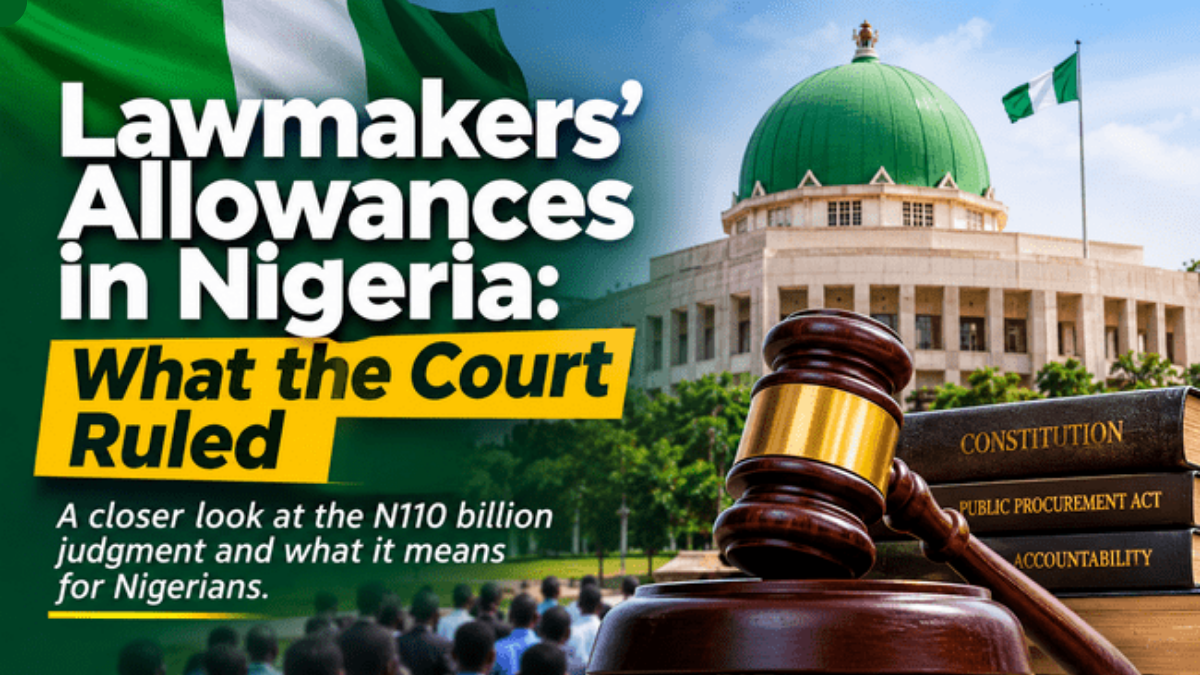
When a court declares N110 billion of public spending unlawful, people pay attention. That is exactly what happened with lawmakers’ allowances in Nigeria this year. A Federal High Court in Lagos ruled that the National Assembly broke the law when it set aside money for vehicles and support allowances for its own members.
The ruling matters beyond the headline figure. It raises a basic question about public money. Who decides what lawmakers receive, and who checks them? This article explains what the court decided, how the National Assembly responded, and what could happen next.
What the court ruled on lawmakers’ allowances in Nigeria
Justice Yellim Bogoro delivered the judgment on May 6, 2026. The public only learned of it weeks later, when the certified true copy became available in early June.
The case covered two items. The first was N40 billion to buy 465 vehicles for senators and members of the House of Representatives. The second was N70 billion in support allowances for newly elected lawmakers, approved under the 2022 Supplementary Appropriation Act. Together, the two items add up to N110 billion.
The court declared both unlawful. It found that the spending breached the Public Procurement Act, the Code of Conduct for Public Officers, and the oath of office that lawmakers swear. The judge also noted that the evidence did not show the spending followed due process, and described it as arbitrary.
The court also directed Senate President Godswill Akpabio and House Speaker Tajudeen Abbas to make sure future spending follows the rules on due process, transparency, and accountability.
Who brought the case, and why it matters
The Socio-Economic Rights and Accountability Project, known as SERAP, filed the suit in August 2023. It acted after reports that lawmakers planned this spending while poverty and insecurity were getting worse. The case took almost three years to reach judgment.
The National Assembly tried to block the case. Its lawyers argued that legislative autonomy kept the matter out of the court’s reach. The court disagreed. It held that autonomy does not shield actions that may be unconstitutional or unlawful.
The judge also waived the usual three-month pre-action notice because of the public importance of the matter. The court then confirmed that SERAP had the right to sue. That point matters for ordinary Nigerians. It confirms that civil society groups can use the courts to challenge how government spends public money.
Why the judge raised a conflict of interest
One finding stands out. Lawmakers approved the money, and lawmakers stood to receive it. The court said that put them in a conflict of interest and described the arrangement as self-dealing.
The judge also took note of the economic hardship facing Nigerians. In that setting, the court said, setting aside N110 billion for lawmakers’ benefit showed a failure to put the national interest first.
This reasoning goes beyond technical rules. It speaks to a simple idea of fairness. People should not decide their own benefits without outside checks.
Who is supposed to fix lawmakers’ pay?
Section 70 of the Constitution answers this. It says members of the Senate and the House of Representatives receive the salary and allowances that the Revenue Mobilisation Allocation and Fiscal Commission (RMAFC) determines.
Courts have raised this point before. In 2021, the Federal High Court in Lagos ordered RMAFC to fix lawmakers’ pay to reflect Nigeria’s economic realities. That ruling also held that the National Assembly Service Commission has no power to set the remuneration of members.
After the latest judgment, Senior Advocate Femi Falana urged RMAFC to enforce Section 70 and fix the salaries and allowances of National Assembly members. He also asked lawmakers to obey the court without delay.
What the National Assembly says
The Clerk of the National Assembly, Kamoru Ogunlana, said the National Assembly bureaucracy will appeal. He described the judgment as declaratory, which means it states the legal position instead of ordering a specific action. He also said the 9th National Assembly duly appropriated the funds for the statutory entitlements of members of the 10th.
Senate Leader Opeyemi Bamidele made a related point. He said lawmakers do not fix their own pay, because RMAFC does. That argument speaks to salaries. The judgment, however, dealt with a vehicle purchase and support allowances approved through the budget.
Both positions will likely come up again if the case reaches the Court of Appeal.

What happens next
Three things deserve attention.
First, the appeal. The National Assembly has said it will challenge the judgment. Watch whether it files an appeal and what grounds it raises.
Second, the refund demand. On June 20, SERAP wrote to Akpabio and Abbas. It gave them seven days to ensure that lawmakers return every kobo received under the scheme. SERAP also asked for public hearings on lawmakers’ budgets in every budget cycle, and for the National Assembly to publish detailed budget and spending information.
Third, RMAFC. The commission holds the constitutional power over lawmakers’ pay. Whether it acts will show how seriously institutions take the ruling.
What it means for ordinary Nigerians
The N110 billion figure grabs attention, but the bigger lesson is about process. Spending that benefits the people who approve it needs outside scrutiny. Without that scrutiny, the risk repeats every budget cycle.
Many Nigerians reacted online by comparing the figure with the state of public hospitals and schools. That reaction reflects a real concern about priorities. When money goes to vehicles and allowances, less remains for services people use every day.
Citizens do have tools. You can read the National Assembly’s budget lines when they are published. You can follow groups that track public spending. And you can ask your representatives how they voted on allowances and procurement. These steps are small, but they build the pressure that makes institutions follow the rules.
Conclusion
The ruling on lawmakers’ allowances in Nigeria does not end the debate. An appeal is coming, and the refund question remains open. But the judgment sets down clear markers. Public money must follow procurement law. Lawmakers cannot approve their own benefits without scrutiny. And citizens have the right to ask courts to check both.
Whatever the Court of Appeal decides, the case has already changed the conversation. Nigerians now expect clearer answers on who gets paid what, and why.