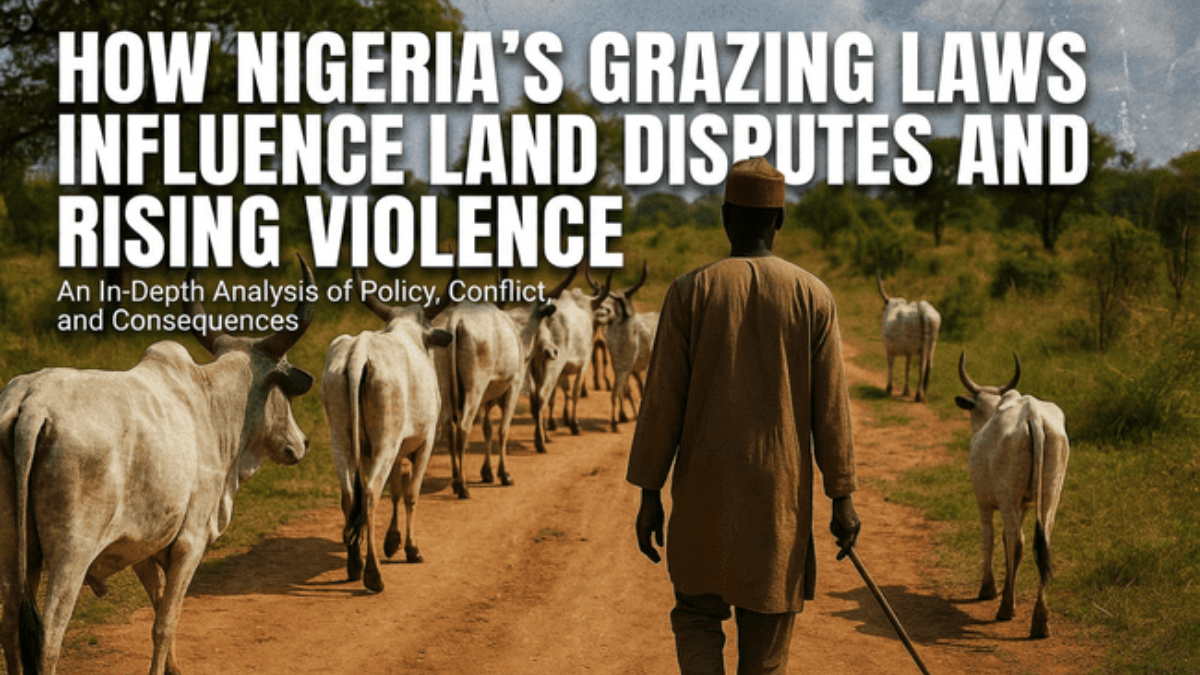
In the Middle Belt and other southern parts of the country, there is one issue that finds itself right at the center of every debate. It is discussed at markets, at village forums, and during local security forums. It is a question of how grazing practices affect the use of land and the rising encroachment of violence that appears to creep closer every year. The grazing laws, initiated for the purpose of safeguarding land and minimizing conflicts, reveal a complex narrative in how they affect the use of the land.
Often, the purpose of state-based grazing bylaws is very clear. Crops will get damaged when cows are left to graze. Farmers will lose revenue. They will also feel insecure. They will force the authorities to do something, hoping the law will provide a lasting solution to the problem. What will happen on the ground, however, will not always relate to the initial intention. Bylaws covering the grazing of cattle affect the movement of the livestock. They also affect the ways and means of the pastoralists, the farmers, and the authorities when there is a dispute.
The long journey from grazing reserves to outright prohibition
In the past, the Nigerian government attempted to control the migration of pastoralists by setting up grazing reserves. This provided the pastoralists with specific routes and open spaces, especially in the north. For a good period, this arrangement worked. However, the population continued to boom, and the land was used for agriculture and settlement. This caused the grazing reserves that were initially large enough for the pastoralist routes and fields to become small.
However, with the rising complaints, the states resorted to tough legislation that banned open grazing and the movement of cattle. It initially seemed like a good approach. Farmers are expected to work without fear of imminent loss. Communities felt that peace had come. Nevertheless, these policies also brought about new realities. Pastoralists, who moved their livestock seasonally, could not use predefined grazing routes. Land used for agriculture covered the routes. Land became a valuable resource, not a communal one.
The transformation did not only affect the manner of the shepherds. It altered the very meaning of the land. Land that was used by many was suddenly the preserve of a few. Societies that welcomed the passage of cattle could now view them as strangers. Those systems that were flexible suddenly found themselves on the battlelines of rights.
Effect of the Laws on Disputes in Practice
The initial manner in which the law affects the conflict is by reducing the area accessible for grazing. As the movement of the cattle becomes criminalized over large areas, the only remaining choices for the pastoralist are to avoid the areas or roam the land through the bushes or fields. Both choices portend potential clashes. Farmers view the slightest misstep as mischief. Herder resistance is harassment. Potential for tension exists well before the fields are touched.
The second factor that affects the problem of pastoralists vs. farmers is how the communities respond to the new limited space. As soon as the corridor is declared off-limits, the communities immediately attempt to settle the area. Farming develops along the previous grazing routes. Communities recreate the unofficial boundaries. The communities attempt to secure their control over the new areas of land. When pastoralists attempt to enter or settle, even for a short time, the communities view it as trespassing. They have the support of the law, so they can defend their territory with conviction. Land ownership disputes contribute, and small conflicts often trigger large-scale fighting.
The third way the law impacts the conflict is the emergence of community guards. This is because when the law is stringent, but the level of enforcement is minimal, the communities end up forming their own mechanisms for enforcing order. Young people start stopping cattle. The level of vigilantism continues to escalate. Herder communities also come up with their mechanisms of defending themselves. This, which started as order enforcement, ends up as a dispute. Every group perceives that it is fighting for its rights.
The underlying forces that the law fails to deal with
It is easy to think that the problem lies with the movement, but the underlying forces are much deeper. Every year, the drying effects of climate change reduce the pasture in the north, forcing the pastoralists south, come what may. Land for cities and agriculture is going up, leaving no space for migration pathways. Water sources become limited. In the rural areas, the presence of the state is minimal, meaning that cases are not often brought to the courts or any other form of mediation.
Because the laws do not prioritize these pressing demands, the problem is merely shifted, not solved. Herders driven out of one country simply go to the next. Farmers become disheartened with the system if they realize that the cows are still coming regardless of the existence of the law. Each camp perceives the absence of the government. This gives way to anger, and people take the law into their own hands.
What the research and experience indicate about results
Studies and reports reveal varying results. In some areas, destructive grazing is reduced when tough legislation is enacted. But for many, something else is seen. The dispute does not end. It merely relocates or turns nasty. Without the routes that cows used to take, which were understood by all, the likelihood of encroachment rises. Herds avoiding the beaten track and entering hidden areas make farmers feel even more insecure. Furthermore, when the sanctioning patterns are irregular, individuals take it upon themselves to administer the law.
This explains the increasing level of violence, at times, after new rules emerge. This is not because the new rules are bad, but because they emerge in areas where land is already a problem, the institutions are fragile, and grievances are still alive.
What factors can help lower the incidence of conflicts
For violence to be effectively decreased, policies must reflect local realities. Legislation works well when supplemented by strategies that provide better alternatives for both parties. The restriction is not enough. They need structures that will allow them to live together without fear.
Identifying the construction of well-supported grazing corridors or ranching areas where pastoralists feel they are not driven away is also essential. Such corridors should also be developed through genuine consultation to avoid posing a problem for the construction of farming areas. Identifying the problem of ownership of the land is also a significant next step. Once the boundaries are well defined, minor conflicts will not escalate immediately.
Increased community mediation efforts also contribute significantly. There are various groups that can form early warning systems, like the traditional leaders, youth, farmers, and pastoralists. When these committees are operating effectively within their areas, the tension decreases, and the pastoralists and farmers also trust the system.
Finally, the government has to ensure that the law is applied equally. If one community is targeted for persecution, the other for protection, peace will not come. This is because trust is developed. Fear is reduced. This provides room for cooperation.
Conclusion
It is easy to understand the effects of grazing-related laws on Nigerian land by listening to the people living with the experience of the tension. These laws affect the use of the land, the boundaries, and the manner in which people are protected on the issue to their rights. They provide solutions for current conflicts, but new challenges are generated since they address the symptom, not the problem. But for lasting peace, Nigeria requires not only restrictions. It also demands alternative measures for the herdsmen, defined land rights for the farmers, mediation mechanisms, and enforcement that gives a fair measure of justice for each of the factions. It is only when these components work together that conflicts will subside, and the rebuilding of trust will commence. It is only then that the nation can leave the cycle of fear and violence.