For decades, the return of the Benin Bronzes was treated like wishful thinking — something people talked about in activist circles or whispered about in museums. The world had accepted that these cultural treasures were gone, scattered across Western museums, locked in glass boxes far from home.
But now, something remarkable has happened.
The Benin Bronzes are coming home.
This isn’t just about metal artifacts. It’s about memory, about justice, about reclaiming history that was stolen at gunpoint. For Nigeria, this return is more than symbolic; it’s a correction of something deep and personal. It’s a spiritual and political turning point that says: We remember who we are.
What Are the Benin Bronzes, and Why Do They Matter?
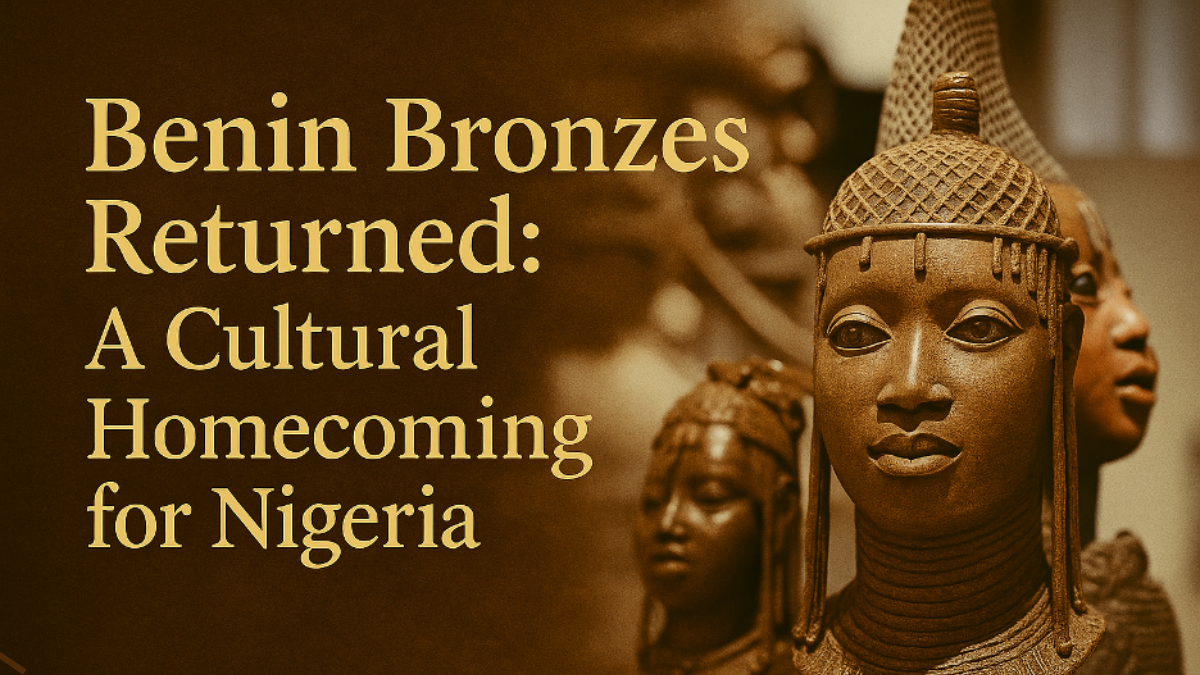
The Benin Bronzes are some of the most important works of African art ever created. They were produced in the Kingdom of Benin, in present-day Edo State, between the 13th and 19th centuries. These works, made of brass, ivory, and wood, include plaques, sculptures, and ceremonial regalia used by the royal court of Benin.
But they are not just decorative. Each piece is a historical record, a story, a ceremony, a moment frozen in time. They document rulers, ancestors, rituals, wars, and even diplomacy. In the context of the Benin Kingdom, these items held power. They were part of religious rites and royal tradition.
To steal them wasn’t just theft — it was cultural violence. It was erasure.
A History of Theft Disguised as Empire
Back in 1897, British troops came into Benin City, not quietly, not politely, but with fire, bullets, and an agenda. They called it a “punitive expedition.” The truth? It was a raid.
They stormed the palace, exiled the Oba, and tore through the city like it meant nothing. What they took wasn’t just treasure, they carried off meaning. Bronze plaques, ivory figures, ancestral shrines. These weren’t just artworks. They were memories. Spirit. Bloodline.
Some pieces dated back hundreds of years. They held names, stories, and energy. The kind you don’t hang on a wall. The kind you pray with.
Yet to the invaders, they were trophies. They looted thousands of objects, packed them up, shipped them out, and scattered them across European museums like souvenirs. A few were gifted, many were sold. All of them were stolen.
And then came the applause.
In London, Berlin, and Paris, people stood in galleries, marveling at African brilliance, never stopping to ask, How did these things get here? Who did they belong to?
Meanwhile, the people of Benin had nothing left. No altars. No images of their ancestors. Nothing to pass down.
They weren’t just robbed. They were silenced.
Over a hundred years have passed. And still, the bronzes stayed locked behind glass, while the heart of Benin waited.
Now, they’re coming home. And it’s not just about the return.
It’s about what was taken. And what never stopped echoing
The Fight to Bring Them Back
For nearly a hundred years, Nigerians, especially from Edo State, have been demanding the return of the Benin Bronzes. From Obas to artists to academics, the call never truly stopped. But the West responded with excuses. Some said Nigeria lacked the facilities to store them properly. Others claimed returning artifacts would “empty museums.”
But the world began to change.
In 2020, the murder of George Floyd sparked global protests not only against racism but also colonialism. People began to question who had the right to hold cultural heritage. African voices grew louder. Hashtags, petitions, and documentaries — all added pressure.
Germany announced it would return hundreds of bronzes. Universities in the US began sending pieces back. And even the British Museum, one of the largest holders, found itself under fire. The long-denied possibility was now becoming reality.
The fight worked because people didn’t give up.

Why the Return Matters
To many in the West, these might just be beautiful artifacts. But to Nigerians, especially the Edo people, they are living history.
These bronzes are not just art pieces — they’re spiritual objects, they’re ancestors, they’re pride. They connect today’s generation with a powerful past that colonialism tried to erase. Their absence created a cultural wound, and their return begins to close it.
This return is also a statement. It says Nigeria’s past matters. It says African heritage is not property to be passed around. It challenges the world to rethink how museums are built, how history is told, and who gets to own the past.
It’s not just about getting something back. It’s about getting a piece of ourselves restored.
But Can Nigeria Keep Them Safe?
A lot of critics have asked a fair question: Will the returned bronzes be safe in Nigeria?
Nigerian museums have indeed faced challenges — poor funding, weak infrastructure, and even theft. There’s also concern that political interference or corruption could compromise preservation efforts.
But Nigeria is rising to the occasion.
In Edo State, the government and the royal family are building the Edo Museum of West African Art (EMOWAA). This new museum is designed to house and celebrate the returned artifacts. It’s not just a building, it’s a symbol of readiness.
More importantly, the conversation is changing. Nigerians are demanding transparency, investment, and respect for heritage. Civil society groups, artists, and academics are watching closely — because this moment is too important to waste.
And let’s not forget, it was stolen from Nigeria, not neglected by Nigeria. The burden of proof should never have been placed on the victim.
The Global Ripple Effect
What’s happening with the Benin Bronzes is not an isolated case — it’s part of a global shift. Countries across Africa are now actively reclaiming stolen heritage.
Ghana wants back the gold looted during British invasions. Ethiopia is seeking the return of manuscripts and religious treasures. Congo is calling for Belgium to account for its colonial atrocities. Egypt continues to demand the return of its artifacts from European museums.
The West is now being forced to ask: What does it mean to own something that was stolen?
Even Western audiences are starting to push for change. Museums face increasing pressure to be transparent about how their collections were built. Academics are challenging old narratives. And young people, both African and global, are demanding restitution and repair.
The return of the Benin Bronzes could be the turning point. A spark that lights a continent-wide cultural revival.
This Isn’t Just About the Past, It’s About the Future
When the bronzes return home, they don’t just go back into storage. They enter classrooms, exhibitions, and conversations. They inspire new generations of artists, historians, and citizens.
This return is a lesson in justice, a study in resilience, and a story of cultural survival.
For too long, African nations have been told that they have no history, or that their history belongs in someone else’s museum. That era is ending. Slowly, painfully, but surely.
This is how legacies are rebuilt, not through speeches, but through action. Not through guilt, but through restoration.
Conclusion: A Homecoming That Rewrites History
The return of the Benin Bronzes is not a favor. It is not charity. It is justice long delayed.
Their return reminds the world that Africa is not a forgotten archive. It is alive. It is watching. And it is reclaiming its story.
These bronzes will no longer sit behind glass in foreign cities, stripped of meaning. They will live again — among the people who understand them, among the descendants of those who created them.
And perhaps that’s the most powerful part of all. Despite being stolen, sold, and scattered, these treasures found their way home.
Not because the world suddenly grew kind, but because Nigeria never stopped asking.