
Nigerians hardly agree on anything, but there seems to be a consensus between the majority of the political class and the citizens that the major hindrance to Nigeria’s food security is our love for imported goods. Based on this consensus, successive Nigerian governments have implemented various protectionist policies such as:
• Placing import tariffs on food considered of national importance
• Giving subsidies and low-interest loans to farmers in this sector
• Or even total bans on the importation of these foods.
There’s no doubt about the failure of these policies. What most people are yet to agree on is if the government and people have realized they are misdiagnosing the problem. Some insist the major problem is corruption, some say it’s the lack of state capacity to implement these policies. A wrong diagnosis will always lead to the wrong prescription, then a wrong outcome.
A sizeable number of Nigerians’ staple foods are derivatives of crops not naturally made for our climate, case in point is wheat and Asian rice (Oryza sativa).
Wheat flour bread was introduced to Nigeria on a limited scale during the colonial era. Its consumption increased with the emergence of new urban areas and the growing working class, alongside the rising need for ready-made food in urban centers. Demand took a big leap following the oil boom of the post-Civil War era. Nigeria’s wheat imports grew at 20% per annum through the 1970s. By 1980, Nigeria had become one of the world’s major importers of wheat, consuming one and a half million tonnes per annum.
Wheat is a temperate climate crop. It must go through a hibernation period during winter, which induces flowering and fruiting; this process is called vernalization. Our wheat consumption is around 5–6 million metric tonnes; only 1% of that has been met by local production. 5 million metric tonnes of wheat are imported to make up for the shortage in local production. This is after hundreds of billions of Naira worth of programs and policies have been implemented to encourage increased local production of wheat.
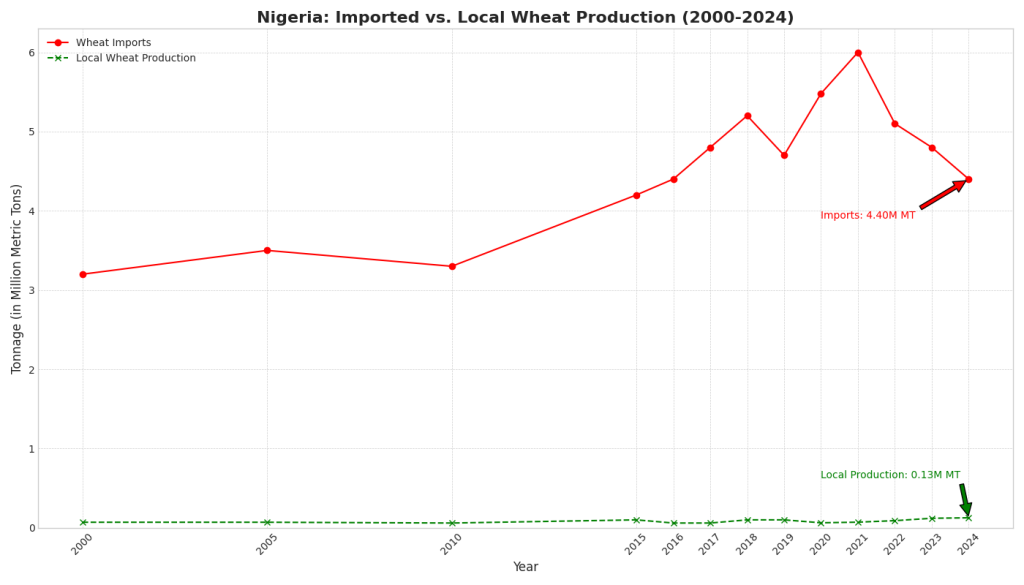
Wheat flour bread was introduced to Nigeria at a limited scale during colonial era, its consumption increased with the springing up of new urban areas and increasing working class, with the growing urban population the need for ready made food. Demand took a big leap following the oil boom of the post civil war era. Nigeria wheat imports grew at 20% per annum through the 1970s, by 1980 Nigeria has become one of the world’s major importers of wheat with one and a half million tonnes per annum.
With the species of rice native to West Africa (Oryza glaberrima) being on the verge of extinction, it only forms 20% of rice production in West Africa and is rarely sold in the market. It has been replaced by Asian rice (Oryza sativa). On paper importation of rice through the land border is banned, but tonnes of rice keeps coming into the country through smuggling, imported rice is the choice of most consumers.
The buhari administration closed Nigeria land borders,hoping this will force change in consumers’ taste and increase patronage of Nigerian rice, the ban was effective as it became hard to smuggle rice into the country but the other aim of the ban wasn’t achieved. Consumers continue to prefer imported rice,local producers have not been able to meet up with demand and their price is also the same as imported rice.
Due to these climate limitations and our present situation in technological progress, there’s no gainsaying we do not have the necessary economic factors to produce this crop efficiently, and it’s best for us to import them.
Both the political class and the everyday Nigerian view importation as a negative phenomenon. Advocating for anything to be imported is considered blasphemous. Yes, their concern about import dependence and it being a drain on foreign exchange reserves is genuine, but with the present interdependence of the world economy, no country can produce everything it consumes. We should instead seek to ramp up production of crops in which we already have an edge and better opportunity costs, whether food crops or cash crops. With increased production of these crops, we can earn enough foreign exchange to cover the cost of importing food that we can’t produce efficiently.

There’s nothing novel about this idea. It has been around for more than a century. David Ricardo developed the theory of comparative economic advantage in 1817. He advocated that countries should focus on goods/services they can produce cheaper and at a better opportunity cost than their competitors; that they should instead import goods/services where they lack or have low comparative advantage. This theory is based on the assumption that all countries have different cost structures and opportunity costs, and that when they focus on their strengths, they produce more efficiently. This is the principle on which international free trade is built.
South Africa is a net exporter of agricultural goods. They recorded a $6.2B trade surplus in 2023, with total agricultural exports of $13.2B. Their major exports were citrus, maize, apples and pears, nuts, wine, soybeans, sugar, wool, grapes, berries, avocados, and fruit juices. While they import goods where they have economic constraints like rice, wheat, palm oil, and whisky 4. South Africa’s economic policy outcomes show the importance of identifying our areas of strength and developing them.
Nigeria is already the world’s largest producer of cassava, third-largest producer of sesame seeds, and fourth-largest producer of ginger.
These are all crops we have a clear-cut comparative advantage in their production. We should instead divert resources being invested in promoting local production of rice and wheat into developing these crops further, especially in going up the production value chain by encouraging processing and value addition.
You would expect Nigeria to make the most money from cassava production as the world’s largest producer, but that hasn’t been the case. Cassava is best processed within 24 hours after harvest. Nigeria’s poor transportation system and underdeveloped processing capacity make that impossible, so most of our cassava is processed and consumed as food, with a large percentage going to waste.
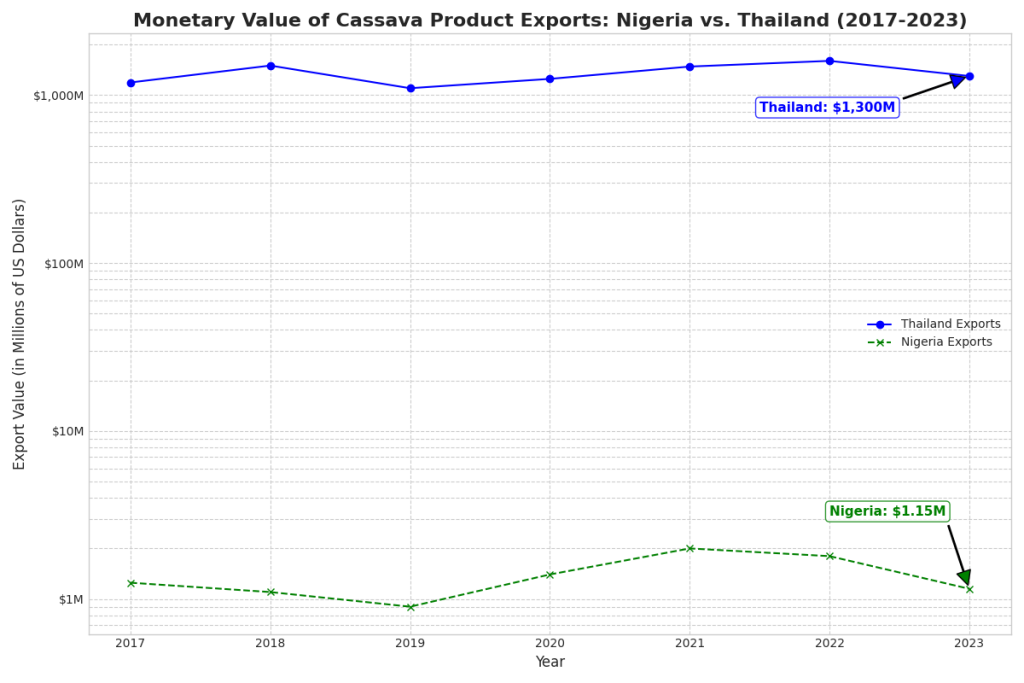
In 2023, Nigeria exported $1.15M worth of cassava, which placed it at number 55 out of 163 cassava-exporting countries. In that same 2023, Thailand, the third-largest producer of cassava, made $1.3B from the export of cassava and cassava products. This made it the highest earner on the list of cassava exporters despite being only the third-largest producer.
To solve our food security problem, we need to embrace sound economic policies and disabuse our minds of seeing importation as bad. This doesn’t mean that in the long run, we shouldn’t seek to develop capacity to produce efficiently some foods we can’t produce efficiently presently, but for now, what our government and policymakers should be more concerned with is our balance of trade and what we’re importing: Are they things we can produce efficiently locally? How important are they to our food security?
To encourage exports of food and a corresponding increase in foreign exchange, the government should take the following measures:
• Implement favorable trade policies and eliminate bureaucratic red tape
• Support farmers and stakeholders across the value chain through targeted programs
• Partner with the private sector to invest in R&D, focusing on high-yield, disease-resistant crops, and improved storage and processing infrastructure
• Establish strong standardization systems and enforce compliance with global best practices, as many Nigerian agricultural products fail to meet export standards due to poor production processes.
Reference
1 The Wheat Trap by Gunilla Andrre and Björn Beckman, page 1 introduction