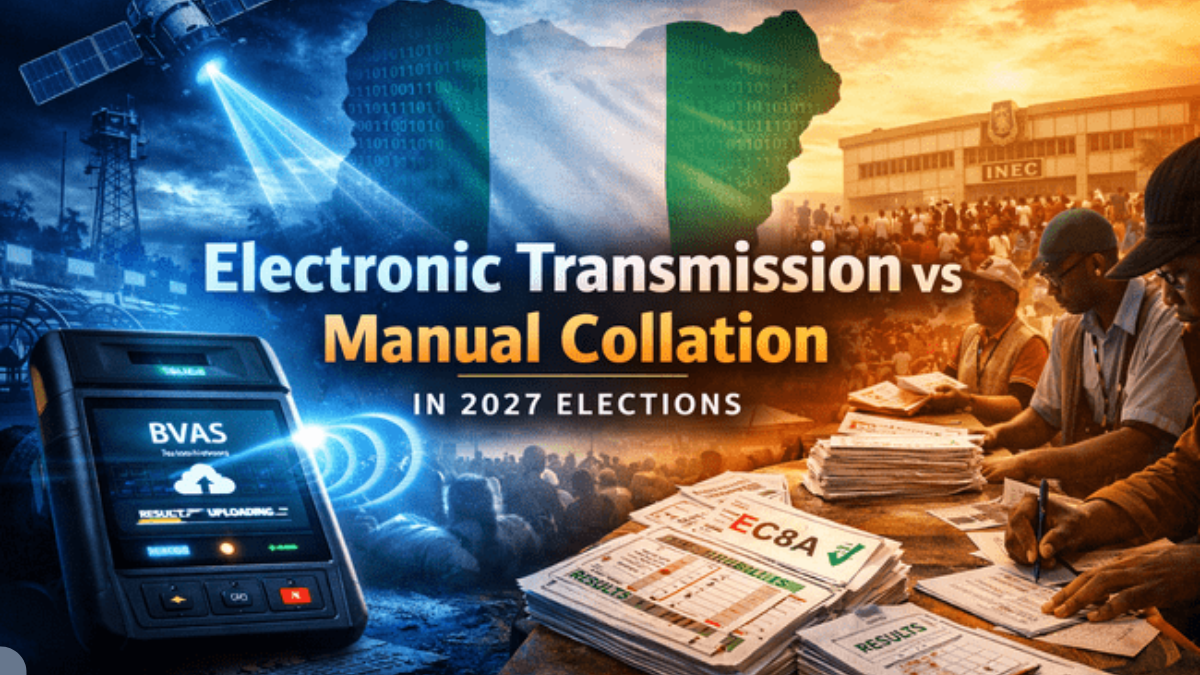
The debate over electronic transmission vs manual collation has already become the defining issue shaping expectations for Nigeria’s 2027 elections. On February 18, 2026, President Bola Ahmed Tinubu officially provided the presidential assent to the Electoral Act (Amendment) Bill 2026, a move that signals a significant shift in the legal architecture of our democracy. For the average citizen, this wasn’t just a routine legislative update; it was a critical intervention in a long-standing national anxiety. We are currently navigating a high-stakes transition where the primary focus is no longer just on the act of voting, but on the integrity of the data. At the heart of this evolution is the intensifying debate over electronic transmission vs manual collation, a clash that represents the struggle between digital accountability and the opaque traditions of the past.
For the Nigerian voter, the polling unit has traditionally been a site of civic hope, while the collation center has often been viewed as a “black box” where results are vulnerable to human interference. From a sociological perspective, the method by which votes move from a physical ballot box to a central server is a direct reflection of the social contract. When citizens endure long hours to cast their ballots, they are entering into a pact with the state, trading their time and trust for the promise of an accurate count. However, the “manual” journey of those results has historically been the point where this contract is most fragile.
The 2026 Amendment: Legalizing the Digital Guard Dog
To understand the 2027 outlook, we must look at what exactly changed in the law just days ago. The Electoral Act 2026 is essentially a ruggedized version of its 2022 predecessor. Its most lauded feature is the statutory codification of the Bimodal Voter Accreditation System (BVAS). In 2023, the legal “loopholes” surrounding BVAS allowed for arguments that its use was merely at the discretion of the Independent National Electoral Commission (INEC). The 2026 law removes that ambiguity. It is no longer a choice; it is a mandate.
Furthermore, the new law gives explicit recognition to the IReV portal. This is a massive win for transparency. The “glitch” that haunted the 2023 presidential results has been addressed not just with better servers, but with harsher consequences. Under the new guidelines, any official found guilty of intentionally blocking or falsifying an electronic transmission faces a mandatory minimum of ten years in prison. By turning “technical errors” into “criminal offenses,” the law is attempting to force a culture of accountability onto a system that has long thrived on plausible deniability.
The Sociology of the “Danger Zone”
In Nigerian political circles, we often talk about the “Danger Zone.” This is the physical and temporal gap between the announcement of results at your local primary school (the Polling Unit) and the final aggregation at the Ward or Local Government collation centers. Historically, this is the “black box” where the will of the people goes to die. It is the three-hour drive on a lonely road where a box containing 200 votes for Candidate A somehow arrives at the center with 2,000 votes for Candidate B.
The demand for electronic transmission is, at its core, a demand to eliminate the “Danger Zone.” When results are transmitted instantly via BVAS to a public-facing portal (IReV), the result is “born” in the public eye. It becomes a permanent digital record before any politician’s “enforcer” can get their hands on the physical paper. For the Nigerian voter in 2027, the electronic signal is a digital escort that protects their vote from the “manual” temptations of the road.
Why Manual Collation Still Lingers
Despite the digital push, the 2026 Act maintains the manual EC8A form as a backup. While this makes sense from an engineering standpoint (you always need a physical fallback in areas with zero connectivity), it creates a sociological “Trust Gap.” In a high-trust society, a backup is seen as a safety net. In a low-trust society like Nigeria, a backup is often seen as a “Plan B” for rigging.
The tension between electronic transmission and manual collation is a reflection of our societal split. On one side, we have a tech-savvy youth population (Gen Z and Millennials) who trust code more than they trust characters. On the other side, we have an “Old Guard” political class that feels most comfortable in the opacity of paper and ink. The 2027 election will be the ultimate test of which world holds the most power. If the manual “backup” is used too frequently, it will signal to the public that the digital guard dog has been muzzled.
Breaking the Cycle of Voter Apathy
We cannot talk about election technology without talking about the people. In 2023, we saw a staggering level of voter apathy in certain regions. Why? Because many Nigerians concluded that the “process” didn’t matter if the “collation” was compromised. Applied sociology tells us that when a population perceives a system as rigged, they don’t just get angry; they withdraw.
The electronic transmission vs manual collation debate is the only way to lure that disillusioned voter back to the booth. The 2027 voter needs to see that their digital “receipt” matches the final tally. If INEC can prove that the transmission is seamless—using the satellite internet upgrades promised in the 2026 budget—we might see a resurgence in civic participation. People will vote if they believe the “arithmetic” is honest.
The “Glitch” as an Institutional Weapon
In the past, the word “glitch” was used as a shield. It was a way to explain away failures without pointing fingers at individuals. However, the 2027 electorate is far more sophisticated. In the years leading up to this election, Nigerians have become world leaders in fintech and digital entrepreneurship. We know that if a banking app can handle millions of transactions per second, an election portal can handle 176,000 polling units.
The expectation for 2027 is the end of the “Glitch Era.” The 2026 Electoral Act mandates that INEC conduct national stress tests six months before the polls. This is a direct response to the sociological demand for “Proof of Work.” We are no longer accepting “we tried our best” as a valid excuse for a crashed server. In 2027, a glitch will be seen not as an accident, but as an act of sabotage.
Conclusion: A Choice for the Future
The road to the 2027 elections is already being paved with the intentions of the 2026 Electoral Act. We have the law, we have the technology, and we certainly have the passion. What remains is the execution. The choice between electronic transmission vs manual collation is more than a technical preference; it is a choice between a Nigeria that looks forward and a Nigeria that looks back.
As we move closer to the ballot, we must remember that technology is only as honest as the people who operate it. But by making transmission mandatory and the IReV portal a legal reality, we have at least given the truth a fighting chance. In 2027, the Nigerian voter doesn’t want a miracle. They just want their math to be respected.