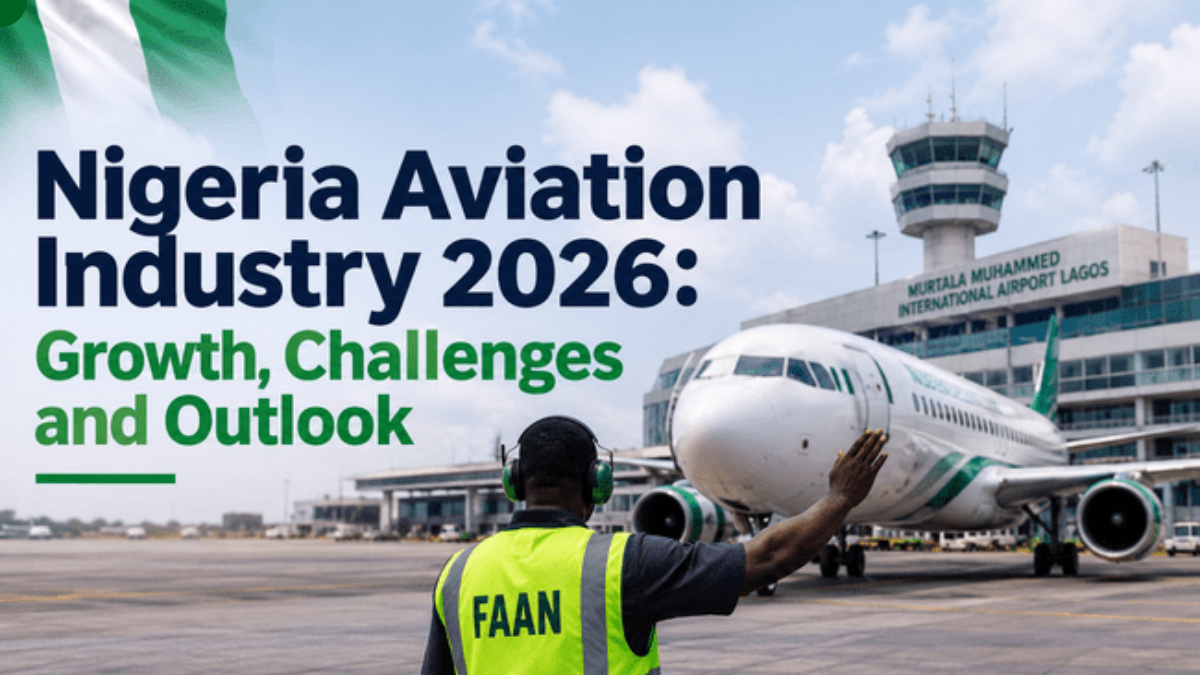
The Nigerian aviation industry in 2026 is growing and struggling at the same time. Airlines are adding seats at a record pace. Yet official output fell sharply early in the year, and passengers still face delays and high fares. This article walks through what the numbers show, what went wrong, what went right, and where the sector may head next.
How big is the Nigeria aviation industry in 2026?
FAAN says Nigeria recorded more than 18.8 million passengers in 2025, up 11.9 percent on the year before. That makes it Africa’s fourth-largest aviation market. FAAN’s own traffic report puts the 2025 total a little lower, at about 17.9 million, so the exact figure depends on which document you read. Domestic flying makes up about 73 percent of all passengers.
Capacity keeps rising. Scheduled seats reached about 1.19 million in September 2026, which is 37.4 percent more than a year earlier. OAG data shows that this was the fastest growth among Africa’s ten largest aviation markets. Domestic seats grew even faster, by 44.8 percent.
What is behind the growth? FAAN’s managing director points to currency reforms, new aircraft leasing agreements and rising airline confidence. Lagos airport added seat capacity faster than any other major African airport, at 24.1 percent.
The sector also matters to the wider economy. An IATA report from October 2025 says aviation adds $2.5 billion to Nigeria’s GDP, which is about 0.7 percent of the total. The industry employs roughly 39,500 people directly and supports over 217,000 jobs once suppliers and spending are counted. That report uses 2023 and 2024 data, so the figures are a little dated.
Africa’s market is still small by global standards. FAAN’s managing director notes that the continent carries only about one percent of global air traffic, despite holding roughly 18 percent of the world’s people. That gap shows how much room Nigeria has to grow.
Why the Nigerian aviation industry shrank in early 2026
Official output tells a different story from seat counts. Air transport generated ₦55.74 billion in the first quarter of 2026, down from ₦105.77 billion a year earlier. That is a 47.3 percent fall in nominal terms. Real output, adjusted for inflation, still dropped by 7.62 percent. The sector’s share of nominal GDP fell from 0.11 percent to 0.05 percent.
The slump ended a long run of gains. It was the first nominal contraction since early 2024 and broke seven straight quarters of growth.
The jet fuel shock
Fuel explains much of the damage. A war between the US-Israel side and Iran pushed jet fuel prices up worldwide. Nigerian airlines paid about ₦900 per litre in February. By April, the Airline Operators of Nigeria said members paid about ₦3,300.
The airlines pushed back hard. They threatened to suspend operations from April 20. The stakes are high because fuel can take 30 to 40 percent of an airline’s operating costs, according to IATA data.
The government stepped in quickly. Keyamo wrote to the airlines and asked them to hold fares steady and drop the shutdown threat. He also called an emergency stakeholder meeting for April 22. President Tinubu then approved a 30 percent discount on statutory fees that airlines owe aviation agencies. The fuel regulator, NMDPRA, recommended an indicative price of ₦1,760 to ₦1,988 per litre in Lagos and ₦1,809 to ₦2,037 in Abuja. It also urged marketers to consider a 30-day credit window for airlines.
Prices eased after that. In May, Dangote Refinery cut its Jet A1 price to ₦1,650 per litre from ₦1,750. The refinery also promised 30-day interest-free credit backed by bank guarantees, and a move from dollar pricing to naira pricing. That matters because Dangote supplies most of the country’s jet fuel, with over 90 percent of the market, according to one marketer.
Fuel is not the only burden. The business group CPPE says taxes, fees,s and levies can take as much as 35 percent of airline revenue.
A record safety score
Not everything went badly. An ICAO validation mission in April 2026 gave Nigeria a 91.45 percent score, up from 70.12 percent in the 2023 audit. The result beats the global average of 70.4 percent and the West African average of 61.1 percent. One caution applies. The NCAA said ICAO would still put the results through further validation, so the score is provisional.
Airlines, airports and new partners
The government settled one long argument this year. In June, Aviation Minister Festus Keyamo ruled out a national carrier. He said public money should back private airlines instead. That same week, United Nigeria Airlines received the first two of six Boeing 737-800 aircraft.
Nigeria also signed a deal with Airbus. The May agreement covers technical support, training for pilots and maintenance staff, and advice on maintenance, repair and overhaul (MRO) facilities. It also opens talks on sustainable aviation fuel. Keyamo tied the deal to Airbus’s forecast of demand for 1,490 new aircraft in Africa over two decades.
Airport concessions finally moved. The government signed the Enugu airport concession in January and handed Port Harcourt airport to a private operator for 30 years on November 12. Keyamo explained the logic plainly. Profits from the major gateways currently prop up airports that lose money, and private investors can develop the commercial side of those airports. He says earlier attempts ran into union resistance and legal disputes, and that this time the government talked to the unions first. Proposals have also arrived for Benin and Yola airports.
Earlier in the year, the picture looked bleaker. FAAN’s managing director warned that inconsistent policy and failed concession attempts had scared off investors. She also pointed to the Terminal One reconstruction in Lagos as work under way.
Delays still frustrate passengers.
Reliability remains the weak spot. NCAA data shows 4,765 of 7,961 domestic flights ran late in August 2026. Another 36 were cancelled. Airlines say they carry only part of the blame. Operators cite airport congestion, weak infrastructure and weather. One industry executive added that labour unions disrupted Lagos and Abuja airports in August. In practice, airlines, airports, regulators and ground handlers all share responsibility.
Outlook for the Nigeria aviation industry 2026 and beyond
The demand side looks healthy. African airlines grew international passenger demand by 6.4 percent in July 2026, while global international demand slipped 0.1 percent. Africa’s overall passenger demand rose 5.2 percent, against 0.2 percent worldwide. Nigeria’s size gives it room to grow. FAAN’s managing director notes that about 19.5 million passengers a year use 28 airports in a country of more than 220 million people.
The same speech listed the obstacles. She named funding limits, infrastructure gaps, high operating costs, fragmented connectivity, and pressure to keep airport charges low.
Three things will decide the next phase. First is fuel. Marketers say Nigerian jet fuel prices follow international benchmarks and the naira exchange rate, even with a local refinery. Second is follow-through on airports, since signed concessions still need to turn into better terminals. Third is the passenger experience, because more seats mean little if flights keep running late.
Concluson
The Nigeria aviation industry 2026 story has two sides. Capacity, safety scores and partnerships point up. Fuel costs, taxes and delays pull the other way. If concessions deliver, fuel stabilises and punctuality improves, the sector can turn this year’s seat growth into real output growth.