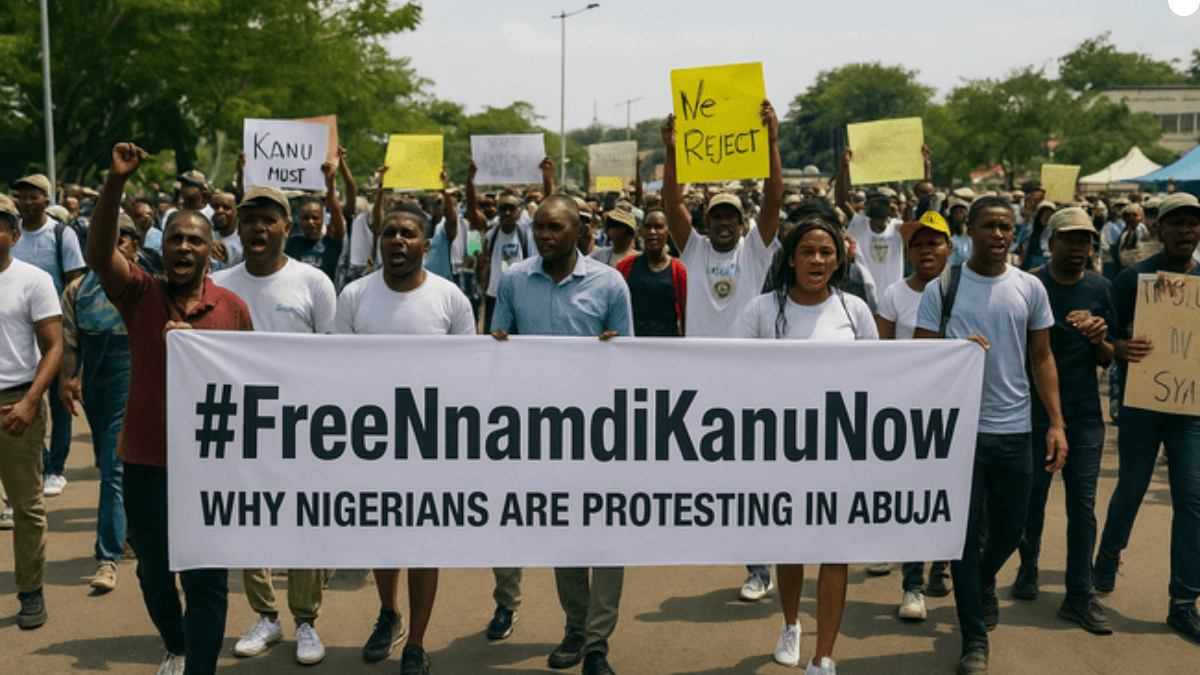
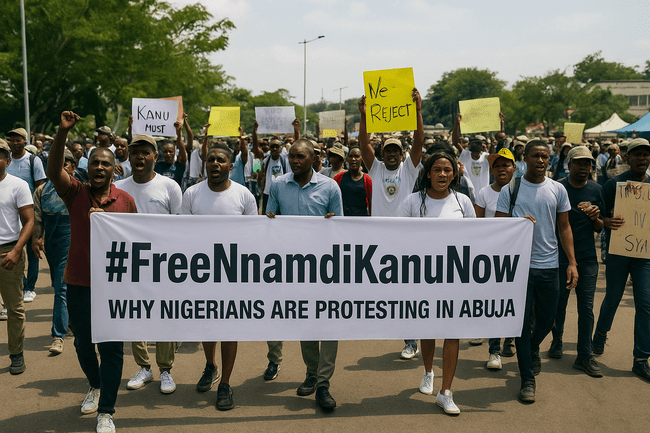
In the streets of Abuja, the atmosphere is charged. From Eagle Square to the National Assembly, youths hoist placards emblazoned “#FreeNnamdiKanuNow”. They chant through the capital: “Obedience to court orders is not a privilege, it’s a right!”
Protest, while peaceful, comes laced with deep-seated anger. For Nigerians, it’s not just this man. It’s about justice, equity, and the essence of the Nigerian democracy. To put this eruption of the capital into perspective, you have to start where the story started: with Nnamdi Kanu, the man who became the embodiment of resistance and separatism.
Who Is Nnamdi Kanu? Why was he arrested?
Nnamdi Kanu, the Indigenous People of Biafra, has been controversial for a long time. To some, he is a freedom fighter seeking independence for the South-East region. To others, he is a threat to the unity of Nigeria.
His detention goes back as far as 2015, when he faced treasonable felony and terrorism-related charges. He was later placed on bail in 2017 but skipped the country following the attack on his Abia State residence by the military. He was re-arrested outside the country and returned to Nigeria in June 2021, though the circumstances are unclear.
He was later arrested by the Department of State Services (DSS), despite the court, on several occasions, ruling for his release. In October 2022, the Nigerian Court of Appeal declared his arrest and detention unlawful and struck out the charges leveled against him. However, Kanu remains detained, and the country and the rest of the world responded to the action with outrage.
Why Nigerians Are Marching Now
Abuja protests are not new; this current round is the culmination of years of quiet anger and failed promises. The current spark was the continued disregard for the court ruling calling for Kanu’s release.
It speaks to something bigger for the protesters: a government of selective enforcement of laws. In their minds, if a court ruling can be disregarded so blatantly by so big of a government, then the average citizen doesn’t have much of a chance of justice.
Most of these also view the demonstration as an expression of increasing resentment under the financial squeeze. With inflation hitting, prices for fuel go higher, and joblessness reigns, people have, in the #FreeNnamdiKanuNow movement, an outlet for their frustrations.
It’s personal for some, a cry of fairness to the South-East, the region traditionally frustrated by marginalization and prejudice by the centre.
Voices of the Street: What the Protesters Are Saying
from clips of social media and field accounts, the demonstrators are speaking through passion beyond political lines.
We don’t want war. We want justice,” the young woman holding the flag chanted.
“The court said free him — why is he still locked up?” another protester asked, his voice breaking in frustration.
It’s led by youthful Nigerians, not only in the South-East but throughout the country. They say this has nothing to do with ethnicity, but merely the rule of law and responsibility.
Their placards have strong messages:
A nation that imprisons dissidence is not free.
“Respect the courts or lose the people.”
#FreeNnamdiKanuNow, Justice delayed is democracy
They are the voices of a generation weary of promises and hungry for real change.
Government Response and Security Response
Nigerian officials have so far been wary. They refuse to say the case of Kanu is anything but “sub-judice” still going on in the courtroom, and due process applies. Critics, though, say this means nothing but delay.
Security officials have been deployed in Abuja to prevent the protests from escalating into violence. Though so far there have been no mass confrontations, the atmosphere remains tense. Heavy police patrols around the locations of protests provide a clear indication that the state is keeping a keen eye.
Such repression mirrors the broader concern: shrinking civic space in Nigeria. Those who demonstrate peacefully are consistently threatened, arrested, or driven back by teargas. The 2020 #EndSARS crackdown remains etched in the collective memory of each protest field.
Several human rights institutions, even Amnesty and SERAP, have warned the government not to resort to the use of force or the disregard of proper court judgments, and have reminded the state that “justice must not only be done, it must be seen to be done.”
The Legal Aspect: What the Law Really Says
According to Section 287 of Nigeria’s 1999 Constitution, all persons and authorities must obey the decisions of courts. The Court of Appeal’s ruling that discharged and acquitted Kanu is legally binding unless overturned by a higher court.
By not releasing him, the government would be undermining the confidence of the people in the judiciary. Lawyers have termed it “a dangerous precedent,” and selective justice undermines the cornerstone of democracy.
In short, if the state can ignore the court rulings on the Nnamdi Kanu matter, then literally nothing protects Nigerians from the law.
Political and Social Repercussions
President Bola Ahmed Tinubu’s government already has huge burdens like economic emergencies, insecurity, and so on. These #FreeNnamdiKanuNow protests are just another complication.
By ignoring the protesters, the South-East might be pushed even further, fueling existing distrust. By releasing Kanu, tensions might be diffused, but the move might be interpreted as caving to IPOB politically.
This fragile equilibrium has put the government in a moral and political quandary. It is the view of analysts that how Tinubu addresses this matter would be the determinant of his credibility for championing national harmony and the rule of law.
Beyond politics, the protests are raising old questions: Is it possible for Nigeria to move on if justice hinges on where you are coming from? And is it democracy once again if the people must fight for the court orders to be enforced?
What the #FreeNnamdiKanuNow Movement Symbolizes
This movement, on the most basic level, is not about any single man. It’s about justice, fairness, and the people’s right to be listened to.
It stands for a nation at the crossroads, between the repetition of the cycle of political arrogance and the path of accountability.
#FreeNnamdiKanuNow trended on all social media and became popular not just in Nigeria but within the diaspora. For most young Nigerians, it is their cry for living in a nation where the law shields and not harasses.
The Prospect Ahead
It can still be settled by peaceful means. Attorneys and human rights advocates are calling for negotiations, challenging the government to respect the ruling of the court, but to have genuine talks with the leaders of the Southeast.
They warn that prolonged detention could radicalize supporters and deepen intra-regional tensions. Releasing Kanu, on the other hand, would be an act of national reconciliation and justice, an expression of Nigeria standing for the rule of law even above political pride.
Conclusion
Abuja protests are the mirror reflecting the broader Nigerian crisis, the confrontation of politics and justice, power and the people. The cries of “#FreeNnamdiKanuNow” might wane in the next few weeks, but the signal would be unmistakable: Nigerians have had enough of selective justice. They crave a nation where laws are inviolable, where the decisions of the courts are upheld, and where any citizen shall be neither above the law nor beneath the law. If the government listens, this would be the turning point of the Nigerian democracy. If not, this would be just another reminder that, in the pursuit of justice, the people shall always be heard.