Step into any home in Nigeria and you will find a blend of brands: a South Korean fridge, a Chinese blender, perhaps a European television. For years, Nigerians have been big importers of home appliances, frequently considering them more robust and reliable than those made at home. But now, in 2025, the story is changing. From air conditioning units made at Aba to Lagos-assembled electric cookers, “Made in Nigeria” home appliances are breaking into the mainstream.
This raises a relevant question: can local substitutes replace imports? This can only be answered based on where the industry is at now, what it is dealing with, and whether or not the Nigerian end-consumer is ready for the transformation.
The Rise of Made-in-Nigeria Appliances
The local manufacturing industry has usually been underutilized, yet home-grown appliance manufacturers have gained significant ground in recent years. Firms such as Thermocool, Polystar, and Bruhm, which at times import parts, are increasingly localizing assembly and even manufacturing of the appliances. Even new startups are catching up with entrepreneurs producing solar-powered fans, rechargeable blenders, and affordable stoves tailored especially for domestic use at home.
The motivation is clear: the cost of importing appliances has skyrocketed due to fluctuations in foreign exchange rates. Local producers are filling that gap with alternatives that are not only cheaper but also designed with Nigerian realities in mind, think power-saving freezers that can keep food cold during blackouts.
Why Nigeria Relies on Importing Appliances
In spite of these advances, the majority of Nigerians prefer foreign products. Why?
Perceived Quality: It is perceived that foreign appliances are rugged and can endure Nigeria’s harsh weather and unstable power supply.
Brand Trust: Brands like LG, Samsung, and Panasonic have gained global reputations trusted by Nigerians.
Durability Fallacies: There has always been a myth that local goods tend to suffer early failures, but this may never prove true.
Status Symbol: For others, driving an import isn’t just about performance, it’s a status symbol.
This mindset remains one of the significant deterrents local producers encounter.
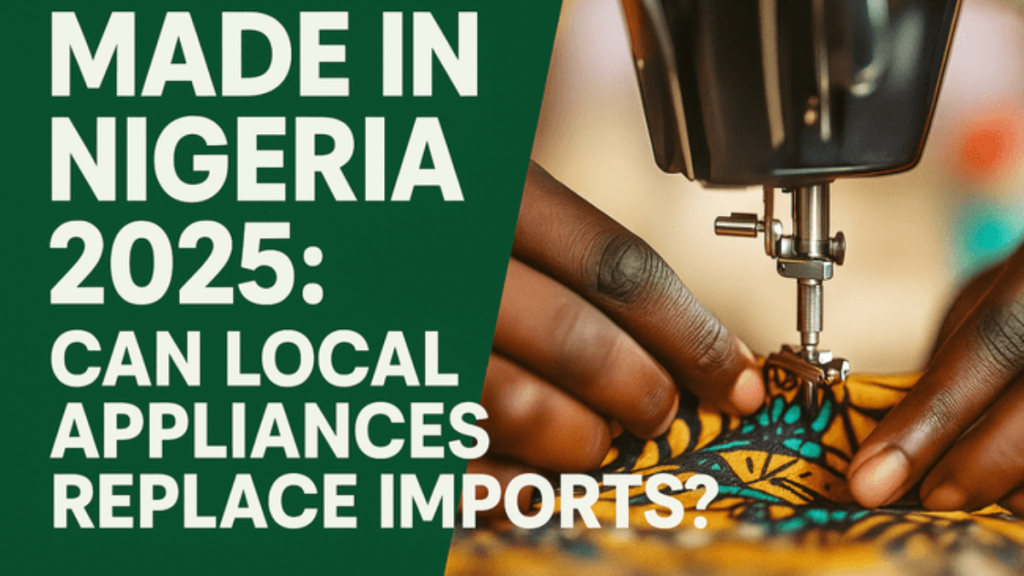
Prospects of Local Fabricants
Even if the predominance of imports can never be negated, local producers have unique strengths that can be exploited.
Job Creation: Locally made appliance generates jobs along the value chain from factory laborers up to delivery men.
Affordability: Locally made appliances avoid heavy import duties and shipping costs, often making them cheaper for consumers.
Customization: Local manufacturers are better attuned to local needs than import brands. Products designed to tackle low voltage or solar inclusion are a great illustration of addressing life head-on within Nigeria.
Export Market: When the African Continental Free Trade Area (AfCFTA) is implemented, made-in-Nigeria home appliances can export and compete in West African markets.
It is not only import substitution; it is making Nigeria a local appliance hub.
Difficulties of Domestic Appliance Manufacturing
It is not all rosé. Local producers have uphill struggles that can’t be overlooked.
1. Power Supply
Ironically, Nigeria’s biggest appliance-manufacturing hindrance is electricity. Frequent power failures make production costlier because factories run on generators powered by diesel. It makes it difficult to scale and reduces profitability.
2. Access to Raw Materials
Many components used in appliances like compressors for fridges or high-grade electrical wiring still need to be imported, exposing manufacturers to forex challenges.
3. Consumer Perception
Altering long-standing consumer perceptions of quality will require time, advertising, and gradualness.
4. Distribution and Infrastructure
Infrastructure such as roads, logistics facilities, and storage are under development, and hence it is more challenging for local producers to access national markets than importers with pre-established distribution channels.
Government Policies and Support
The government has realized the need to give local production a push. Various measures have been launched aimed at tilting the scale in favor of “Made in Nigeria.”
Import Tariffs: Higher duties on imported appliances are aimed at making Nigerians purchase local.
Grants and Loans Access: By virtue of schemes like the Bank of Industry loans and the intervention funds of the Central Bank, some manufacturers have greater access to credit.
Renewable Integration Incentives: Solar-powered and energy-saving appliance-promoting policies favor local innovation.
Public Procurement Policies: Certain state governments are now targeting local producers when they buy office and school appliances.
They are encouraging policies that can only succeed if complemented by sustained enforcement and investment in infrastructure.
Health and Environmental Implications
Then there is the health and environmental perspective of the argument. Second-hand appliances imported from elsewhere the common thing in Nigeria are usually outdated and emit dangerous greenhouse gases or use a lot of energy.
Through local production using new green designs, Nigeria can achieve a reduction of its carbon footprint. Energy-efficient home appliances are equally effective at lowering home electricity bills, a significant advantage where power supply is not only erratic but also highly charged.
This benefits families by ensuring healthier home environments and less exposure to malfunctioning or dangerous electrical products, which flood the shelves at times.
Consumer Attitudes: Quality or Price
At the very epicenter of it all is the Nigerian consumer. Can one change their loyalty from imports to local brands?
The solution is based on two main things: price and trust. Although the locals are very price-sensitive, if local appliances are cheaper and don’t lose too much on quality grounds, they can gain market share.
It is harder to build up trust. Manufacturers need to invest money in warranties, after-sales facilities, and publicity campaigns emphasizing ruggedness and innovation. It will have more impact if a fridge withstands power fluctuations or a fan runs on solar backup rather than just a “buy local” slogan.
Do Local Appliances Stand a Chance?
Outside Nigeria, other countries like China, India, and Brazil have allowed indigenous industries to mature and take control of their home markets and export abroad. Nigeria has the numbers, hunger, and entrepreneurial spirit to accomplish the same.
One must depend on three things:
Consistent Quality – Nigerians won’t do anything except if it is local.
Government Support – Consistent policy, infrastructure, and supply of power need enhancement.
Consumer Attitude – Nigerians have to come to regard patronizing local industries as patriotic and sensible.
If these are aligned, Nigeria can significantly reduce import reliance over the next ten years.
Conclusion
The question isn’t whether made-in-Nigeria goods can replace imports, but whether Nigeria is capable of building an economy where indigenous innovation can take root. Imports aren’t disappearing anytime soon, but every blender, fan, or television made within Nigeria puts Nigeria one step further toward economic self-reliance. In 2025, Nigeria is at a crossroads. Potential is enormous, yet so are the problems. Here’s what is certain: a sustained and concerted effort at quality local manufacturing can reshape Nigeria’s manufacturing sector and perhaps just give “Made in Nigeria” pride of place in every home.