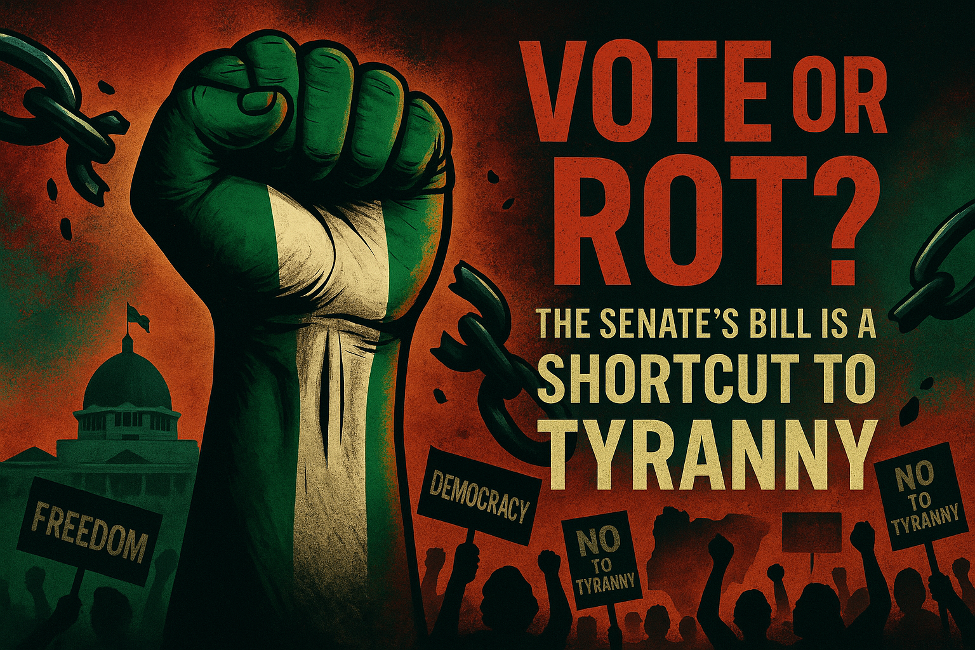
In a country where democracy still limps on bruised legs, the Nigerian Senate has proposed a bill that could punish citizens for not voting. Imagine compulsory voting in Nigeria by 2025, with jail time or fines for anyone who dares to skip elections. What sounds like a civic push for engagement is starting to resemble political coercion in disguise. The Senate bill is a shortcut to tyranny—thinly veiled under the guise of patriotism and civic duty.
Voting is a right, not a leash. Turning it into a legal obligation in a country plagued by voter suppression, rigged results, and violence feels less like reform and more like tyranny dressed in legislative robes.
What the Bill Proposes
The controversial bill proposes mandatory voting for all eligible Nigerians. Refusal to vote could attract penalties ranging from fines to jail time. On the surface, it seems noble. But scratch deeper and you’ll see a system trying to force legitimacy through fear rather than trust.
Supporters say it will strengthen democracy. Critics, however, know better; you don’t fix low voter turnout with threats. You fix it with credibility.
The Right to Vote Is Also the Right Not to
Voting is a democratic right, not an obligation enforced by fear. In any free society, the decision to vote, abstain, protest, or spoil a ballot is personal. By attempting to criminalize abstention, the Nigerian government is weaponizing democracy against its people. It’s no longer about choice; it’s about compulsion.
How do you compel a starving man to vote when the people he once trusted at the ballot box have left him to rot? How do you threaten a youth who watched the #EndSARS movement get gunned down only to see the perpetrators walk free?
The question should not be “Why are Nigerians not voting?” but “Why have Nigerians lost faith in voting?”
For many Nigerians, elections are not symbols of hope. They are days of tension, rigging, and violence. Ballot boxes disappear, votes are manipulated, and those who win are often selected long before a single vote is cast.
So, when the Senate pushes a bill to punish non-voters, one has to wonder: are they blind, or do they simply not care? For decades, Nigerians have cried out for transparency, justice, and free elections. Instead, they are being told to vote or rot.
Let’s be clear, this bill isn’t about encouraging civic participation. It’s about bullying citizens into legitimizing a broken system. And that, at its core, is authoritarianism dressed as democracy.
Forced Patriotism Is Not Patriotism
The Senate’s new bill rests on a dangerous assumption: that Nigeria’s problem is the people’s apathy. That if only more people voted, the country would change. But that’s a lie. People voted. People waited in the sun, stood in long queues, and braved election-day violence. And what did they get?
They got the same recycled leadership. The same corruption. The same heartbreak.
Voting is not a magic wand. It is a tool—one that only works when the electoral system is free and fair. Forcing people to use that tool when the system itself is rigged is not patriotism. It is tyranny.
Weaponizing Civic Duty
The idea of compulsory voting in Nigeria 2025 reeks of something darker: the political class trying to hijack participation as a tool for self-preservation. If every citizen is legally forced to vote, those in power stand to benefit the most—especially when electoral fraud still runs deep.
What happens when an oppressed citizen refuses to support a corrupt system? Should they be punished for resisting their own manipulation?
This is how democracies rot—from the inside out, using the law as a weapon rather than a shield.
Is the System Even Ready?
Let’s talk logistics. Nigeria still struggles with:
- Incomplete voter registration.
- Inaccessible polling units in rural areas.
- Election day violence.
- Mass disenfranchisement due to poor INEC logistics.
Before you mandate voting, can you guarantee every citizen safe, equal, and stress-free access to vote?
Mandatory voting without fixing the structural mess beneath it is like painting a collapsed building and calling it a mansion.
The Danger of Silence
This bill must not be allowed to pass quietly. Civil society, youth groups, journalists, lawyers, and citizens must rise to resist it. This is not just about voting—it’s about freedom. Today, it’s the vote. Tomorrow, it could be a speech. Or movement. Or even thought.
History shows us that tyranny never begins with violence; it begins with silence.
We must not be silent.
Let’s Talk About Real Reform
If the Senate genuinely cared about democracy, it would focus on:
- Electoral Transparency and Independent INEC Operations
For any democracy to thrive, the electoral commission must function independently without interference from politicians or the ruling class. INEC must conduct free, fair, and credible elections that reflect the genuine will of the people. - Protecting Voters from Intimidation and Violence
No citizen should fear going to the polls. Nigeria needs security systems that prevent electoral violence, protect voters, and ensure a peaceful atmosphere throughout the voting and collation processes. - Prosecution of Electoral Offenders
Vote rigging, ballot snatching, and vote buying destroy democracy. Electoral offenders must be swiftly prosecuted under the law to deter future manipulation and uphold the sanctity of elections. - Education and Civic Enlightenment
Many Nigerians are not fully aware of their civic rights. Nationwide voter education campaigns are essential to teach people about the importance of voting and holding leaders accountable. - Removing Godfathers and Money Politics from the System
Political godfathers and financial backers often hijack the electoral process. Real reform must break this grip, promoting leadership based on vision, integrity, and service—not wealth or connections.
Conclusion
The Senate’s bill to criminalize non-voting is an insult to the Nigerian spirit. It is undemocratic, unnecessary, and ultimately dangerous. Instead of addressing the rot in the system, the Senate has chosen to threaten the very people it was elected to serve.
To vote or not to vote is a right. Not a favor. Not a privilege. And certainly not something the government should regulate with fear.
Let’s call it what it is: a shortcut to tyranny.
Let us resist. Let us speak. And let us remind our leaders that democracy cannot be forced. It must be earned.