
In late March 2026, a single tweet by Captain Jamil sparked what may yet become a defining moment in Northern Nigeria’s evolving political economy. Jamil proposed a home-grown “Shark Tank” initiative: a venture fund designed to identify promising youth-led businesses across the Arewa region, invest in them through equity partnerships (co-ownership rather than interest-bearing loans), and scale them into sustainable enterprises.
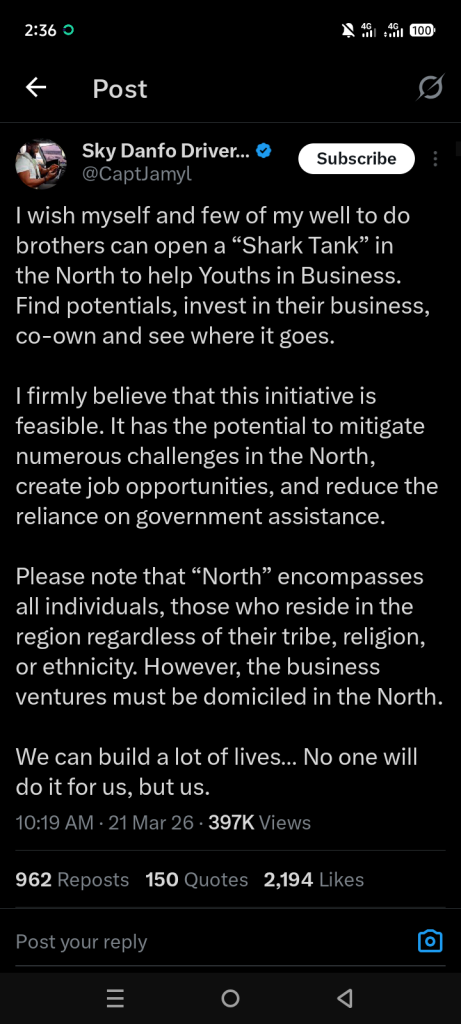
The response was quick and impressive. Within 24 hours, pledges reportedly exceeded ₦100 million, drawing contributions from prominent Northern elites and generating widespread enthusiasm across digital platforms such as X (formerly Twitter) and Instagram. Young entrepreneurs expressed eagerness to pitch ideas, while supporters framed the initiative as a landmark step toward economic self-determination in the region. What appeared at first glance to be a simple crowdfunding success story quickly revealed itself as something more profound: a social experiment at the intersection of culture, religion, class, and economic transformation.

This essay argues that the Arewa “Shark Tank” is sociologically significant not merely because of the capital it mobilizes, but because of the cultural terrain it navigates and the structural tensions it exposes. It represents a hybrid model of development—one that attempts to reconcile Islamic ethics, communal traditions, and modern capitalist practices within a region often portrayed as resistant to economic change.
Understanding the Arewa Economic Model
Northern Nigeria occupies a unique position within the country’s socio-economic landscape. Predominantly Muslim and heavily influenced by Hausa-Fulani traditions, the region mostly prioritizes communal solidarity, moral obligation, and religious adherence over individualistic economic pursuits. Systems of redistribution such as zakat (obligatory charity) and sadaqah (voluntary giving) are not merely financial mechanisms but deeply embedded moral imperatives that shape social relations and define communal responsibility.
Yet this moral economy coexists with persistent structural challenges. Data from Nigeria’s National Bureau of Statistics consistently show that Northern states lag behind their Southern counterparts in key development indicators, including literacy rates, school enrollment, income levels, and access to healthcare. Youth unemployment and underemployment are particularly acute, with some estimates suggesting that more than half of young people in certain Northern states are either jobless or engaged in precarious forms of labor (see reports from the World Bank on Nigeria’s youth employment).
Compounding this is the continued presence of the almajiri system, a traditional form of Qur’anic education that, in its contemporary manifestation, has been widely criticized for contributing to urban poverty and child vulnerability. While historically rooted in scholarship and discipline, the system has, in many areas, become associated with street begging, social dislocation, and limited economic mobility.
It is within this paradox of strong moral cohesion alongside deep structural deprivation that the Arewa “Shark Tank” manifests as both an innovation and a disruption. By introducing a venture capital model, albeit one adapted to local religious norms, it challenges longstanding assumptions about how economic empowerment should be pursued in the region. Rather than distributing wealth through unconditional charity, it seeks to generate it through structured investment, accountability, and entrepreneurial risk-taking (see venture capital overview).
Between Charity and Capitalism
At the heart of the initiative lies a delicate balancing act: the attempt to reconcile the moral logic of charity with the instrumental logic of capitalism. Traditional philanthropic practices in Northern Nigeria emphasize compassion, obligation, and spiritual reward. Giving is not evaluated in terms of financial return but in terms of moral virtue and communal cohesion.
The Arewa “Shark Tank,” however, introduces a different framework. By adopting an equity-based model. In it, investors co-own ventures and share in profits. This system by Arewa Shark Tank aligns with Islamic finance principles that prohibit interest (riba) while simultaneously embracing the core mechanisms of venture capitalism. This includes competitive selection processes, business plan evaluations, scalability assessments, and mentorship structures.
This hybridization is both innovative and contentious. On one hand, it offers a culturally legitimate pathway to modern economic practices. By framing investment as a partnership rather than exploitation, it avoids the ethical concerns associated with conventional lending. On the other hand, it introduces new forms of discipline that may clash with established social norms.
Public reactions illustrate this tension. Supporters praise the initiative as a transformative step toward self-reliance, arguing that it promotes dignity through productivity rather than dependency through handouts. In a region where economic marginalization is often linked to insecurity (see UNDP reports on insecurity and poverty in Northern Nigeria), such empowerment is seen as both a developmental and stabilizing force.
Critics, however, raise valid concerns. Some view the initiative as performative—an elite-driven spectacle amplified by social media visibility. Others question the fairness of requiring economically vulnerable individuals to compete for support, arguing that such processes may inadvertently exclude those most in need. In contexts where begging is normalized as a survival strategy, the expectation of entrepreneurial readiness can feel like a redefinition of compassion itself.
These tensions echo broader sociological debates about the “moral limits” of markets. As Karl Polanyi argued in The Great Transformation, economic systems are always embedded within social relations and cultural norms. When market logic is introduced into domains traditionally governed by moral obligation, friction is inevitable. The Arewa “Shark Tank” exemplifies this dynamic, forcing a reconsideration of what constitutes ethical and effective economic intervention.
Balancing Social Capital and Structural Inequality
Beyond cultural tensions, the initiative also highlights issues of power and access. The rapid mobilization of ₦100 million underscores the strength of elite networks within Northern Nigeria. Influential actors such as pilots, politicians, entrepreneurs, and digital influencers, were able to leverage their social capital to generate funding and visibility with remarkable speed.
However, this raises a critical question: who gets to participate?
From the perspective of Pierre Bourdieu’s theory of capital, access to opportunities such as this is shaped not only by financial need but also by cultural and social capital. Cultural capital includes skills such as formal communication, business literacy, and digital fluency. These are competencies that are unevenly distributed across populations. Social capital, meanwhile, refers to networks and connections that can facilitate access to resources and opportunities.
In the context of the Arewa “Shark Tank,” these forms of capital may determine who is able to present viable proposals, navigate the pitching process, and ultimately secure investment. Youths from rural or less-educated backgrounds may find themselves at a disadvantage, even if they possess strong entrepreneurial instincts or locally relevant ideas.
This is a common critique of merit-based development initiatives. While they appear neutral and fair, they often reproduce existing inequalities by privileging those who already possess the tools required for success. Without deliberate mechanisms for inclusion—such as grassroots outreach, mentorship programs, and simplified application processes—the initiative risks becoming an elite filter rather than a broad-based empowerment platform.
Social and Economic Potential of the Model
Despite these concerns, the initiative holds considerable transformative potential. By emphasizing co-ownership and mentorship, it addresses a key limitation of traditional aid models: their lack of sustainability (see OECD aid effectiveness principles).
An equity-based model, by contrast, fosters ongoing relationships between investors and entrepreneurs. It aligns incentives, encourages accountability, and promotes knowledge transfer. Investors have a vested interest in the success of the ventures, while entrepreneurs benefit from guidance, networks, and strategic support.
If effectively implemented, this approach could generate significant multiplier effects. Successful businesses create jobs, stimulate local economies, and inspire others to pursue entrepreneurship. In a region with a rapidly growing youth population (see Nigeria demographic data – World Bank), such outcomes are particularly valuable.
Moreover, the emphasis on scalability introduces a forward-looking dimension often absent in traditional charity models. Rather than addressing symptoms, the initiative seeks to build systems of production and value creation. Over time, this could contribute to a shift in collective attitudes—from dependency toward agency, from subsistence toward innovation.
A New Mantra of Development
In a broader global context, the Arewa “Shark Tank” reflects a growing trend toward social entrepreneurship in the Global South. As state capacity remains limited in many regions, private actors are increasingly stepping in to address developmental challenges. However, unlike traditional foreign aid models, these initiatives are often locally driven and culturally grounded.
The Arewa model is particularly noteworthy for its emphasis on indigenous ownership. It does not rely on external donors or imported frameworks but instead draws on local resources, networks, and values. This enhances its legitimacy and increases the likelihood of long-term sustainability.
At the same time, it reflects the influence of globalization and digital connectivity. The concept of a “Shark Tank” is borrowed from global media (see Shark Tank TV format), while the use of social platforms for fundraising and engagement demonstrates the growing importance of digital spaces in shaping economic behavior.
This blending of local and global elements represents a new “mantra” of development. One that is adaptive, hybrid, and context-sensitive. It suggests that modernization need not come at the expense of cultural identity but can instead be negotiated on locally defined terms.
Conclusion
The Arewa “Shark Tank” is more than a funding initiative; it is a site of negotiation. It brings together competing logics such as charity and investment, tradition and modernity, community and individual ambition. The initiative attempts to reconcile them within a single framework.
Its ultimate success remains uncertain. Much will depend on governance, transparency, and inclusivity. Will it deliver measurable improvements in employment and income? Will it reach those most in need, or primarily benefit the already advantaged? Will it sustain momentum beyond initial enthusiasm?
These questions are not merely practical but deeply sociological. They speak to the broader challenge of development in culturally complex societies: how to introduce change without eroding identity, how to promote efficiency without sacrificing equity, and how to integrate global ideas without losing local legitimacy.
What is clear, however, is that the initiative challenges prevailing narratives about Northern Nigeria. It demonstrates that the region is not static or resistant to change but actively engaged in redefining its economic future. By experimenting with new models and adapting them to local realities, it is carving out a distinctive path toward development.
For sociologists, the Arewa “Shark Tank” offers an interesting case study in the evolution of economic systems. It invites us to move beyond simplistic binaries and to consider the complex ways in which tradition and innovation interact.
Ultimately, the question is not whether capitalism belongs in conservative societies, but what form it takes when shaped by their values. In Arewa, that form is still emerging.
And in that sense, the Arewa “Shark Tank” is not just about funding businesses. It is about reimagining the very foundations of economic life in Northern Nigeria.