In Nigeria, “rape” is a word that carries an almost radioactive weight. Just saying it can flatten a career, tear a family apart, and turn an entire neighborhood into a lynch mob before a single fact is checked. Because the stakes are so high, every survivor deserves to be heard with absolute empathy. But that same weight is exactly why we have to talk about the flip side: false accusations. They aren’t as common as the real thing, but when they happen, the “cost of justice” becomes incredibly steep for everyone involved.
It’s an uncomfortable conversation. Many people avoid it because they’re afraid that questioning a claim makes them an enemy of the fight against sexual violence. But silence doesn’t actually help survivors; it just creates a system that can’t tell the difference between a tragedy and a lie. When justice is blind to the truth, it fails everyone.
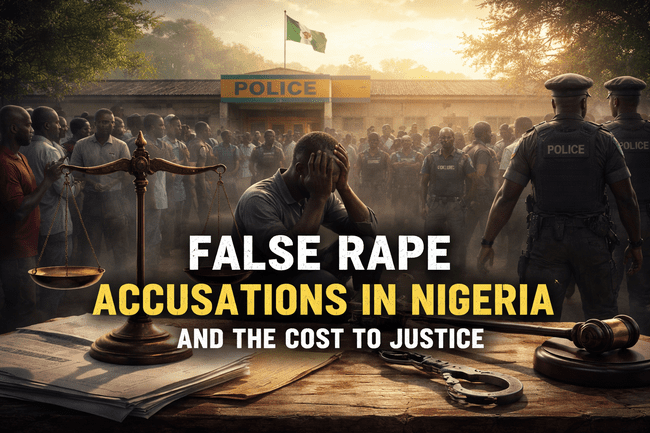
Law on Paper vs. Life on the Ground
On paper, Nigeria takes sexual assault seriously. Between the Penal Code in the North, the laws in the South, and the VAPP Act, the legal framework is there. But “on paper” and “in practice” are two different countries.
Our police stations are often understaffed, and many investigators haven’t been trained to handle the delicate, technical nature of sexual crimes. Forensic labs? They’re a luxury most states don’t have. Because the tools for finding the truth are missing, cases often get fueled by raw emotion and public pressure rather than hard evidence. This creates a dangerous “act now, think later” culture. Mugshots go viral, and arrests are made to satisfy the crowd, but by the time the facts catch up, the person’s life is already in ruins.
The Social Death Sentence
A rape accusation in Nigeria doesn’t stay in the courtroom. It travels through church pews, mosque hallways, and family WhatsApp groups.
The accused often loses their livelihood in a matter of days. Friends stop calling; relatives look the other way. In our tight-knit communities, the stigma moves faster than the law. Even if a judge eventually says “not guilty,” that label, that “stain” never truly washes off. The internet doesn’t have a “delete” button for a ruined reputation. Many of those wrongly accused end up dealing with deep trauma, depression, or forced relocation, finding that “justice” arrived far too late to save their lives.
The Damage to Real Survivors
The irony is that false claims are a massive blow to actual victims. When a high-profile case collapses because it was built on a lie or thin air, it fuels a culture of skepticism. People start asking, “Is she actually telling the truth, or is this another story?”
Nigeria already has a massive problem with underreporting. Between family pressure and a deep-seated distrust of the police, most survivors choose silence. Adding “public doubt” to that mix just builds a higher wall for real victims to climb. Justice thrives on trust; once you erode that trust with high-profile falsehoods, everyone retreats into the shadows.
Where the System Cracks
The real breakdown happens at the very beginning: the investigation. When physical evidence isn’t collected properly or at all, the case becomes a “he said, she said” battle. Medical exams happen too late, and statements are rushed.
When these cases eventually hit a courtroom, they fall apart. The public sees an acquittal and assumes the system is “pro-rapist,” when the reality is often just an investigative failure. This cycle makes the law look weak, and the accusations look unreliable. It’s a lose-lose.
Trial by Social Media
Social media has turned us all into judges. We see a screenshot, and we pass a sentence. Online outrage demands an immediate sacrifice, which pressures the police to perform for the cameras rather than do the boring, slow work of detective work. Headlines scream the accusation, but if a correction ever comes, it’s a whisper on page ten.
Why the Hospital is the Missing Link
One of the biggest reasons cases fail is that our hospitals aren’t ready. Most public clinics lack the kits and the specialized training needed for sexual assault cases. Without forensic evidence, all you have is hearsay. If we equipped our hospitals properly, we wouldn’t have to rely on who tells the better story; we’d have the facts. That protects the victim’s path to a conviction and the innocent person’s path to freedom.
Finding a Middle Ground
The goal isn’t to make it harder to report; it’s to make the process stronger. A fair system treats every report with gravity while sticking to due process.
We need better police training, more forensic labs, and a culture where arrests follow investigations, not the other way around. At the same time, we have to admit that intentional false reporting should have consequences. This isn’t about intimidating victims; it’s about protecting the integrity of the word “justice.”
The Path Toward a Balanced Justice
So, where do we go from here? The answer isn’t to make it harder to report sexual violence; we already have enough barriers in our culture. The answer is to professionalize the response.
- Investigative Reform: We need a specialized unit within the police force that deals only with sexual offences, officers who understand that an arrest should be the result of an investigation, not the start of one.
- Forensic Investment: We must equip hospitals. Every major city should have a 24-hour forensic center where evidence can be processed with scientific integrity.
- Accountability for Malice: While we must protect those who report in good faith, even if the case can’t be proven, we must also have clear legal consequences for those proven to have manufactured a lie with malicious intent. This isn’t about scaring victims; it’s about protecting the law.
- Public Education: We need to move past the “shame” culture. Both the gravity of consent and the importance of the presumption of innocence need to be part of our national conversation.
The Bottom Line
Justice isn’t about picking a side before the facts are in. It’s about the truth. When a system is too weak to filter out lies, innocent people suffer. When it’s too broken to prove the truth, survivors suffer.
Nigeria’s struggle with sexual violence requires empathy and competence in equal measure. Pretending that false accusations don’t happen doesn’t make the system stronger—it just makes it less honest. We need institutions that can tell the difference. Until then, the cost of justice will remain too high for everyone.