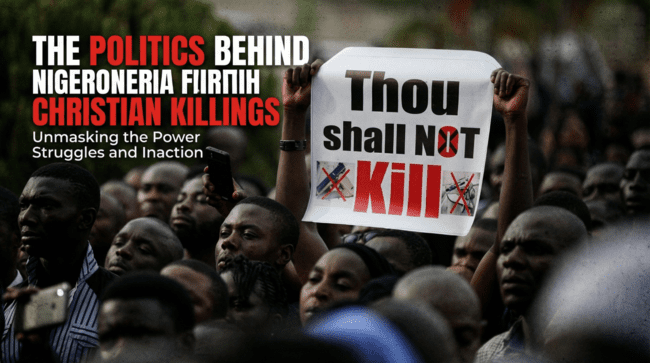
The question that continues to get asked by the people of the Middle Belt and the Northern regions of Nigeria is: why are the killings of the Christians still ongoing, despite the rising pressure from governments and the international community? It appears that the motives for the massacre are sectarian and religious. However, it is also important to examine the underlying political and economic structure that fuels the massacre. The politics of Nigeria’s Christian killings not only define who kills the victims, but also who is overlooked, and who gets justice.
Often, the village congregations go along, leaving their empty, burned-out churches, their homes destroyed, their families scattered, their villages empty. The storytelling happens within the parameters of religious discourse. But it happens often where land, water, grazing routes, and politics come together. This is also where the nexus of faith, land, and politics reveals “what nobody is saying.”
Not just extremist terror: a complex field of actors
There is no question that extremist organizations are present and operating within the Nigerian state. Islamist militants, ranging from jihadists and insurgency organizations, have been actively targeting civilians, including Christians, for several years, mostly within the remote northern regions of the country. Conversely, within the Middle Belt and central areas of the nation, extremist attacks do not always originate with identified terrorist organizations, but rather local militias, disorganized groups, and pastoralist herder groups.
What this means is that the violence is not always the direct result of religious extremist activity. It is, rather, the result of a combination of poor governance, the failure of prosecutors, disputes over land or resources, and local dynamics. Because these armed groups are not well-regulated and are, in fact, protected locally, their strength and violence escalate.
How politics becomes both a motive and a cover
The violence becomes politicized on at least three intersecting fronts. Firstly, local politicians will often exploit intercommunal tensions for their own gain, for example, for political support or for control of resources like land or grazing routes. They will usually condone, support, or simply ignore the violence if it helps them.
Second, the rule of law continues to be selectively and irregularly enforced. This is because, for the most part, the security forces are overstretched, understaffed, or compromised. This gives space for impunity. The people stop trusting the legal system, and they take the law into their own hands by forming militias or other local security initiatives. They become major players, operating with the tacit backing of the local community, who are less likely to face retribution for their attacks.
Third, the international and local discourse on religious persecution, although well-intentioned, could end up oversimplifying the root causes. The conflation of all instances of violence with religious persecution might overlook the fact that, in some instances, the violence could be driven by land disputes, resource competition, ethnic disputes, or criminal activity.
The scale of violence
It appears that the situation for Nigerian Christians is dire. According to recent data, there are alarming numbers of violence against religious groups. For instance, as documented by watchdogs and local NGOs, in the year 2025, thousands of Christians were reported killed, with several others having been displaced. This is because the entire village that used to serve as the avenue for farming and worshiping for the religious group is actually a site for the IDPs.
One of the bloodiest attacks happened in June of 2025, in a village named Yelwata, located in central Nigeria. Gunmen attacked a shelter where internally displaced Christians were living. It is believed that between 100 and 200 people were killed. More people were left displaced. Churches, homes, and markets were destroyed. It was reported that families had been extinguished, homes reduced to ashes, and children were running for their lives amidst gunfire.
Similar attacks also occurred in rural areas of Benue State, among other states, in the early weeks of 2025, leaving entire settlements destroyed, with churches, homes, and hundreds of villages emptied.
The consequence: massive displacement, shattered lives, traumatized children, and the breakdown of rural Christian communities.
Who benefits from the ambiguity?
This is a disastrous state of affairs that allows several types of actors to thrive. Bandits with weapons get stronger and stronger. local elites and politicians build their power through fear and the promise of “protection.” Politicians campaign on the issue of insecurity, promising security and retaliation, sometimes without actually changing anything. Terrorists thrive on disorder: when the state of law is fragile, and the response is weak, they can build their ranks and entrench themselves.
On the other hand, Christian communities lose their homes, their land, their livelihoods, their religious leaders, and often their tomorrow. Trust between neighbors shatters. Society begins to disintegrate. It starts with a cycle of fear, revenge, and suspicion.
What real solutions must look like
“If the politics driving the killings of Nigerian Christians is the cause of the violence, then anything that’s going to address this problem effectively is going to require more than military or law-and-order approaches.”
To start, the situation regarding state capacity and accountability needs to get better. Security forces need investment, training, and impartial supervision, so that crimes are investigated and strongly condemned. Those who commit the crimes need to be brought to justice: bandits, gangs, and politically connected individuals.
Second, disputes about land and resources must also be handled transparently and equitably. Land rights, dispute settlement, and collaborative land use planning can prevent conflicts that are disguised as religious conflicts. This must include local communities.
Third, the political incentives must change. Leaders should reward peace, not fear. Whenever politicians or elites are discovered to derive benefits from or condone violence, they must come into the open and lose their political leverage.
Fourth, the stories and media coverage need complexity. Rarely is the violence in Nigeria simply one thing. International, national, and religious actors should avoid the temptation to simplify the situation into a “religious war.” They should emphasize the role of the intersections between land, politics, criminal networks, identity, and impunity.
Finally, victim support should not only stop at disaster response. The displaced populations require assistance in rebuilding homes, schools, and churches, as well as help for their livelihoods, counseling, and social cohesion.
Conclusion
The violence perpetrated against Christian communities in Nigeria is not merely religious. It is political in intent, technique, and consequence. It is facile, for example, when the murder of Christians is simply catalogued as religious violence, when the other, larger picture is of territorial disputes and resource contention. To bring about lasting change, more than just condemnation is needed in Nigeria. Changes are also needed when it comes to the use of land, better governance, accountability, and the readiness to deal with the politics of the slaughter. This will ensure that violence is not a strategy but dies out.